
As a child, I was steeped in the lore of Captain Cook as a hero of discovery, the great man who ‘found’ Hawai’i, planted the British flag in Australia and explored the ends of the earth. I think the reason for his allure to young boys like myself was that he easily became a simple figure in our imaginations — a mariner with a spyglass and a tricorn hat standing for determination, courage and confidence. No ambiguity, no doubt, no fear.
Is it even possible to celebrate the beauty and artistry of the Indigenous peoples of Oceania without...considering Cook’s travels?
Yet his legacy is not simple. In fact it’s extremely complicated and contested. Yes, he was an intrepid explorer of the Pacific whose ambition served the insatiable greed of European capitalism and the expansion of the British Empire in the 18th century. He was merely doing what many before him had done since Sir Francis Drake followed the Spanish galleons into the Pacific in 1572. In simple terms, Cook resembled his popular image. In the words of his worshipful biographer, J.C. Beaglehole, he was “a man of action.” Lionized all over Europe long after his death, in our time it’s different story: he is vilified for initiating the violence and dispossession of colonialism. In Australia, statues of Cook have been sprayed with “No pride in genocide” graffiti.
All this points to my central question: Who was James Cook, and what new thinking has emerged in our time that can help us understand his decisive influence — both for the indigenous peoples of the lands he visited and for the Western culture that claims him as a hero. While we explore these questions, keep in mind the words of a thoughtful museum curator: “Is it even possible to celebrate the beauty and artistry of the Indigenous peoples of Oceania without considering the tremendous ramifications and consequences and diseases and deaths that Cook’s travels spawned?” (Mallon, 2018)
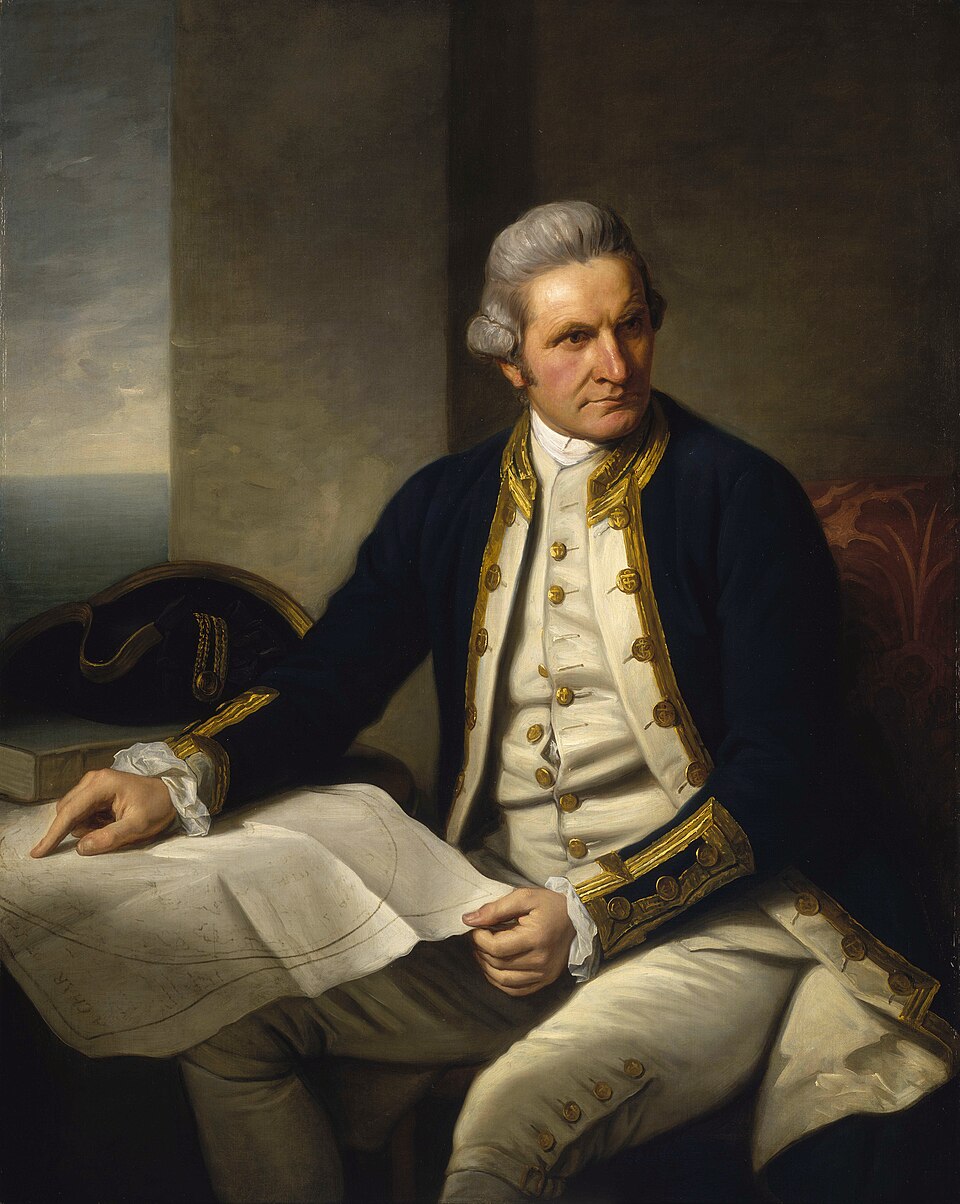
The last portrait of Cook, 46 at the time, before departure on his final voyage. 'Portrait of Captain James Cook RN,' 1776, Nathaniel Dance, oil on canvas. 127 cm × 101.6 cm (50 in × 40.0 in). National Maritime Museum, London.
Born in 1728, Cook came of age in England in the radiant climax of the Enlightenment, a time of expansion, rising power, collective potency and confidence. It was a period of enormous aspiration and grand projects — from Johnson’s dictionary to Diderot’s Encyclopédie, from Voltaire to Thomas Paine. Bold endeavours were undertaken rapidly and with conviction. It was an intoxicating and fertile era; both technical and social revolutions were in the air.
Cook grew up eight miles from the sea in north Yorkshire, the son of a farm labourer. When he was 18 he worked as an apprentice with a Quaker ship-owner in the shipbuilding port of Whitby. Learning to sail and manage collier-barks, he became familiar with the solid utilitarian ships designed to carry coal from Newcastle upon Tyne down to the Thames and the London market. From 1747-1755 Cook qualified as a mariner and navigator on merchant ships in the dangerous waters of the Baltic, the North Sea, and the Irish Sea. When he was offered the chance to be captain of a collier he turned it down to join the Royal Navy as a relatively old and unusually skilled recruit at age twenty-six.
Rapidly promoted to Sailing Master (often shortened to Master), he served in the Seven Years War with France from 1756-73. Fighting in sea battles and land assaults, he was at the siege of Louisburg (1758) and the decisive battle on the Plains of Abraham (1759). His charting and marking of the treacherous shoals and sandbanks of the St. Lawrence River were crucial to the success of Wolfe’s fleet. After the war he returned to what would become Canada in command of the schooner Grenville to survey and map the jagged coastline of Newfoundland. The accuracy of this map in the post-war context had huge mercantile, military and diplomatic value. Through this innovative cartography and even astronomical observations, his genius attracted the attention of the Admiralty and led directly to his appointment as Captain of the HMS Endeavour for the first of his three epic voyages of discovery in 1768.
At 6’2”, Cook was a commanding presence. A perfectionist by nature, he was very concerned with duty, accuracy, cleanliness, and health. Also, known to be sober and chaste with regard to drink and women, he ignored the temptations of the local beauties throughout Polynesia. He had high moral standards but was not religious or mystical, and did not tolerate priests on board his ships. Having risen from among the ranks of able seamen, he had a deep understanding of how best to manage his ships and crews. He had nerves of steel in adversity, but he was also hot-tempered in the face of incompetence or disobedience, particularly as his health (and perhaps his mind) was failing on his third voyage. When he admitted defeat in his search for the southern continent on his second voyage, he described his core motivation in his private diary: “I whose ambition leads me not only farther than any other man has been before me, but as far as I think it possible for man to go…” (Salmond 2004). This ambition drove him to pursue his career above all else. In sixteen years of marriage, he spent only four with his wife and children. She burned all of his letters. Why? Perhaps he had expressed doubts in writing, or criticism of his superiors. Are these signs of weakness inconsistent with his image? Fourteen years younger than James, Elizabeth was jealous of his reputation; in the end she lobbied successfully for him to be awarded a coat of arms posthumously.
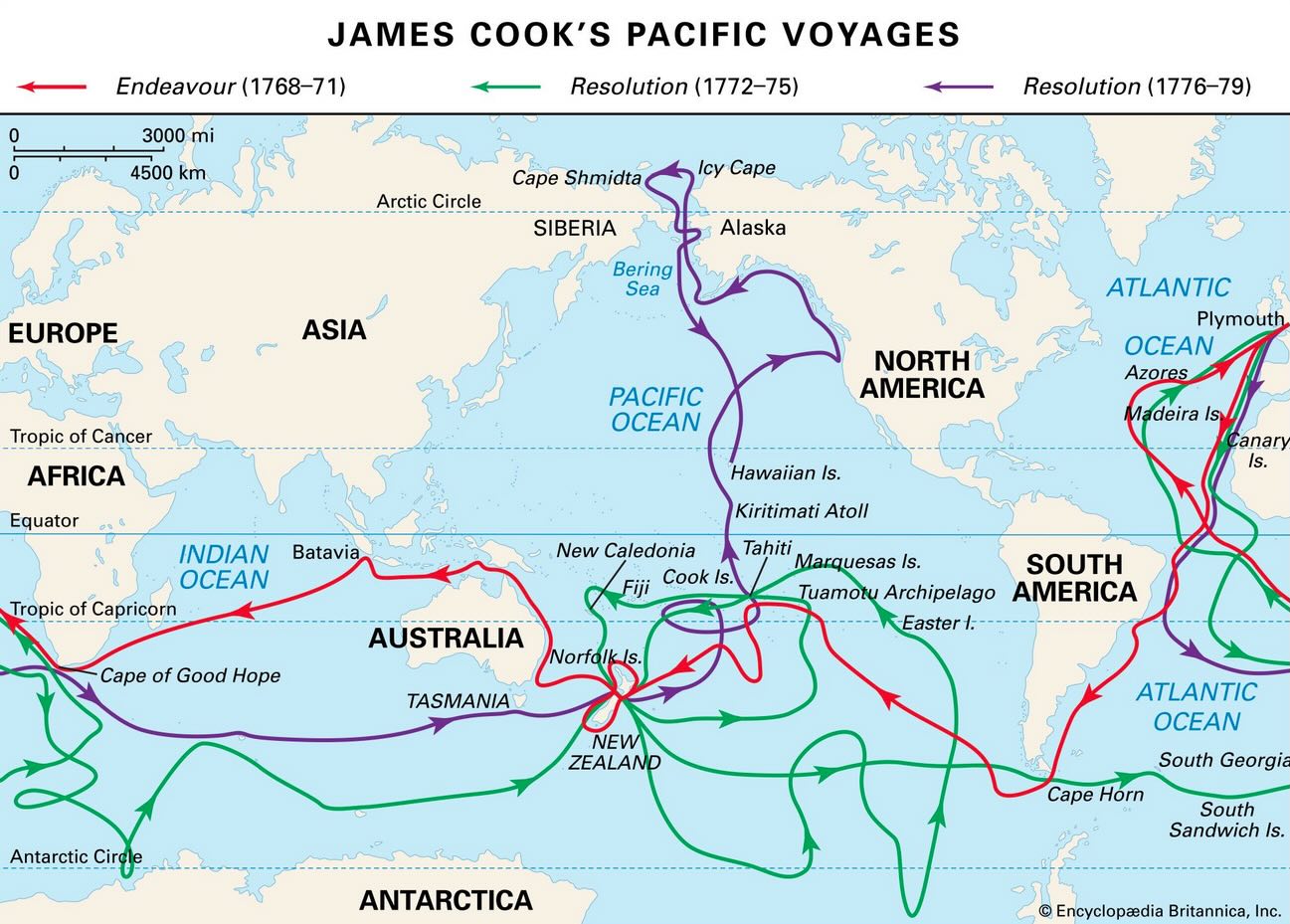
Map courtesy of Encyclopedia Britannica. [o]
COOK’S VOYAGES
Cook undertook three voyages of discovery, scientific inquiry, and imperial expansion for the British Crown in the Pacific. The first (1768-71) was initiated as a scientific expedition to the recently ‘discovered’ island of Tahiti. The official purpose was to participate in an international project to observe the rare astronomical event of the Transit of Venus from several places on Earth, in order to determine the distance of the Earth from the Sun, to solve the navigational conundrum of longitude by parallax. However, Cook also carried secret orders from the Admiralty to search for the fabled southern land mass, Terra Australis, and claim it for Britain. This epic voyage took him around Cape Horn via Tierra del Fuego to Tahiti, and then on to New Zealand and Australia — along the way making detailed maps and claiming the east coast of Australia for his King.
Cook’s second voyage (1772-75), this time with two ships, was intended to reach further and explore southward in the Antarctic summer, to search, again, for the unknown southern continent. On this trip they returned to Tahiti and New Zealand, visited Easter Island and Tonga, and also claimed the remote islands of South Georgia and New Caledonia for Britain. They were the first Europeans to cross below the Antarctic Circle. Due to pack ice and fog, they never reached Antarctica to confirm its existence. On the return, Cook’s erroneous conclusion that there was no continent at the south Pole was widely accepted. He was promoted to post-captain, honoured as “the first navigator of Europe” and reluctantly took retirement from the navy.
The following year, his wish for more action was granted when the Admiralty chose him to lead the search for the Northwest Passage from the Pacific side of America. Cook’s third and final voyage (1776-79), with its aim to expand British mercantile power via a northwest sea route to the Orient, took place while the American Revolution was raging on the east side of the continent. Cook approached the Pacific this time from the east via southern Africa with two ships, first returning to New Zealand and then Tahiti. He went on from there to ‘discover’ Hawai’i where he was welcomed and honoured.
Continuing his quest for the Northwest Passage, he arrived at Nootka Sound on Vancouver island in the spring of 1778. After provisioning and establishing positive trading relations with the Nuu-chah-nulth people, he continued northward to the Bering Strait, charting the northwest coast line, including Alaska, until sea ice blocked the way. Cook’s foul mood and volatile behaviour increased as he turned the expedition southward toward his final and fateful destination in Hawai’i. Two of the great scholars who have written about Cook, Marshall Sahlins and Greg Dening, contend that Cook became the incarnation of an important deity in Hawaii, and that he unwittingly played a role in the mytho-praxis of ceremonial power. By getting involved in this way, he inadvertently but aggressively disrupted that balance, so much so that he had to be killed. We will look more closely at the circumstances and the multiple Rashomon-like explanations of Cook’s death in the third essay of this series.
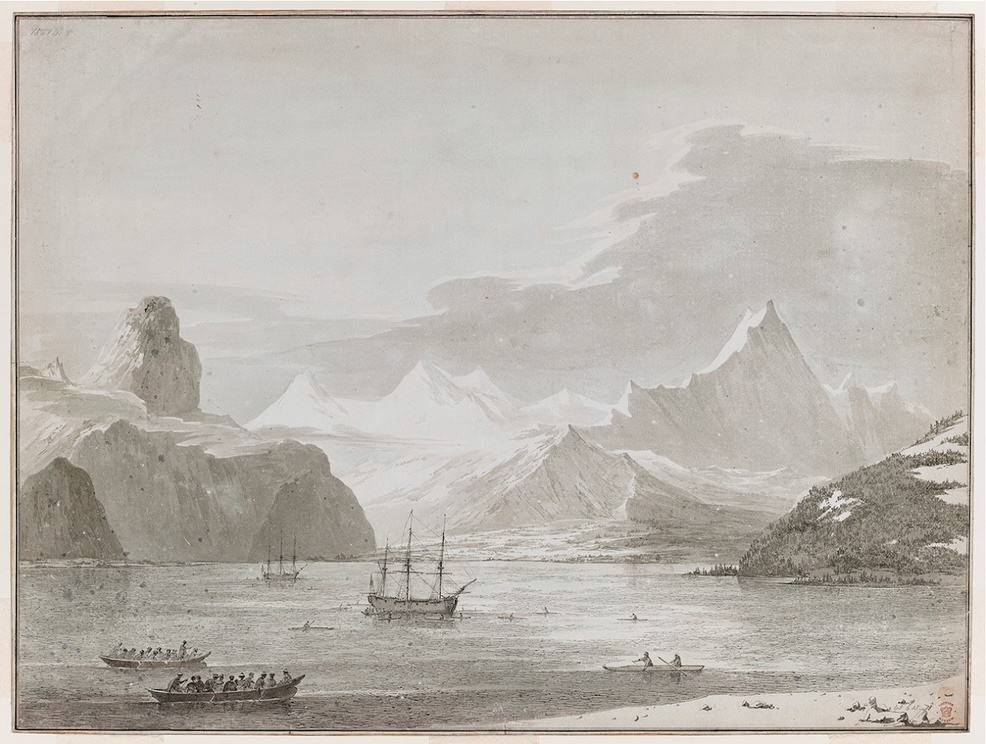
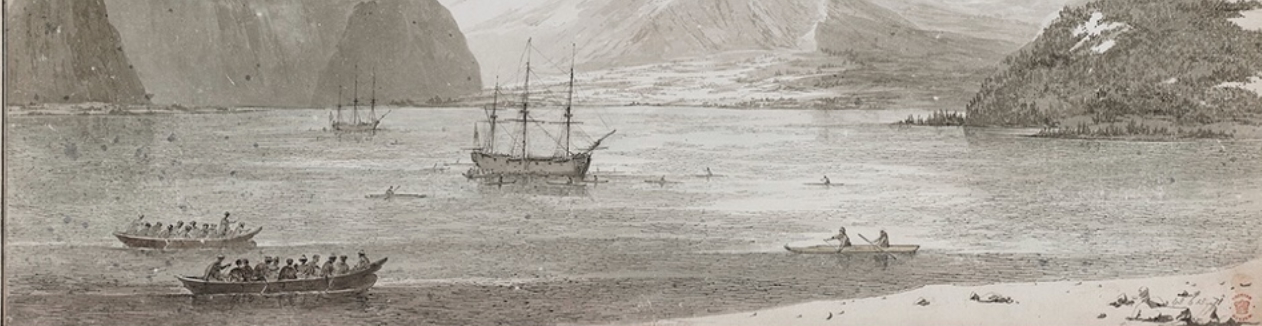
A View of Snug Corner Cove, with the 'Resolution' and the 'Discovery' in the sound, towering ice-covered cliffs on either side. In the foreground, two large canoes crewed by Alaska natives approach the two ships; on right a kayak with two men, and others with single oarsmen. Snug Corner Cove was described in the entry in Cook's journal on 16 May 1778, during his visit to Prince William Sound [Sandwich Sound] from 12 to 20 May 1778. Image taken from the Drawings executed by John Webber during the Third Voyage of Captain Cook, 1777-1779. Originally produced in Alaska [Prince William Sound], 1778 Illustrated by John Webber. Museum: British Library.
On the first voyage Cook regarded himself as an envoy of the Royal Society, as well as a servant of the Admiralty. He had in his care the scientific entourage of the progressive naturalist Sir Joseph Banks, the botanist Daniel Solander, a close colleague of the great Linnaeus, Sydney Parkinson the artist and Charles Green the astronomer. Cook was intent on being an Enlightenment captain, avoiding violence wherever possible. His instructions from the Earl of Morton recognized that the Indigenous people possessed the sovereignty of their own territory and that he must tell his men not to use their firearms immediately, to use small shot to wound, not kill. Morton, the President of the Royal Society of London, urged Cook to check the petulance of the Sailors and restrain the wanton use of Fire Arms
To have it still in view that shedding the blood of these people is a crime of the highest nature... They are the natural, and in the strictest sense of the word, the legal possessors of the several Regions they inhabit. No European nation has a right to occupy any part of their country or settle among them without their voluntary consent. (Salmond 2019)
Cook has been described as a humanitarian, approaching native populations with respect and restraint. On the other hand, he was a naval officer whose job included using violence when necessary to pursue the King’s agenda of claiming new lands for the Crown and, despite Morton’s instructions, on occasion he did shoot to kill.
It is difficult to know from Cook’s published and unpublished papers what he really thought and felt about the customs, cosmology, and the spiritual and sexual practices of the indigenous peoples that he traded with. He did not often confide his private thoughts, and in his written accounts he was acutely self-conscious. His ten years of travel in the Pacific changed him. He was a farm labourer’s son, and being treated as a high chief by these Pacific islanders had a profound effect on him. Perhaps this dual nature was too paradoxical for him to sustain in the end, and led to erratic behaviour, alienation from both his crew and the native Polynesians, and his death.
For some, artifacts in museum displays hold no power of attraction. But if you have a bit of anthropological curiosity, seeing objects that Cook received on his voyages from the natives of Vancouver Island, Alaska, Hawai’i, Polynesia and Australia can be a revelation. These are extraordinarily fine tools, weapons, and objects for ritual and adornment, all bearing the weight of subsequent colonial and settler history. We’re drawn to the numinous energy that we feel from these original artworks drawn from life, and the actual objects given from the hands of Tahitian, Māori, Aborigine, Hawaiian and Nuu-chah-nulth leaders as gifts into Cook’s own hands. The term they used at the time for these ingenious and often beautifully designed things was condescending: “artificial curiosities.” Artificial as opposed to found objects from nature like sea shells and botanical specimens, curiosities because they were foreign, primitive, intriguing, and the Other.
The act of representing (and hence of reducing) others almost always involves some violence of some sort to the subject.
These objects are the material evidence of his travels, Cook’s relics. Over two thousand are scattered in private and public collections on five continents, not just in the British Museum where I found some of them. As we look at this small selection of artefacts, think of them as windows, points of entry into the life and times of the peoples that Cook met along the way. And, importantly, objects mediated by the wonder of novelty and the imperatives of imperial commerce that drove the artists, scientists and sailors who travelled with him.
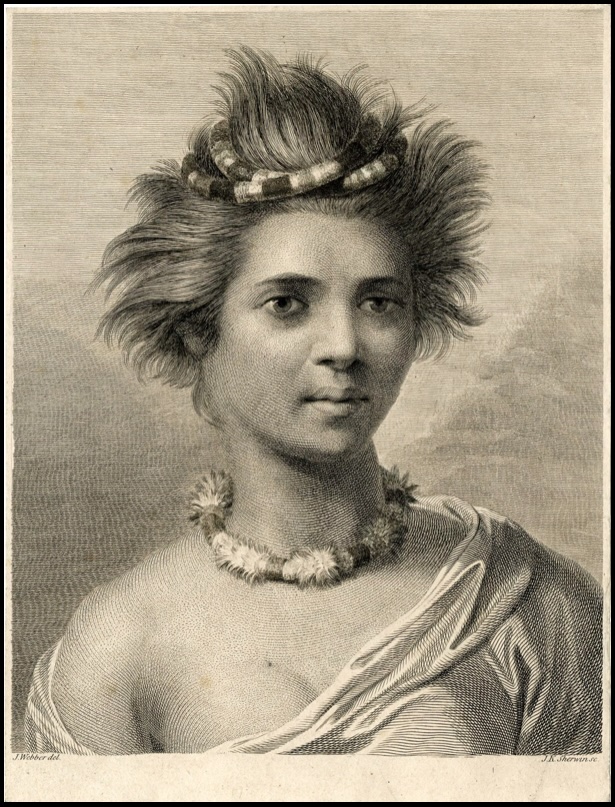
'Hawai'ian Girl', by John Webber, 1784.
The drawings of people Cook’s crew met are strange and fascinating. Produced as illustrations for the inevitable published account aimed at 18th century readers, they are often very attractive objects, and objectifications. But be aware of the Eros effect you may feel toward the image of the Hawaiian girl whose languid eyes whose languid eyes seem touch across oceans and centuries. Edward Said wrote
. . . the act of representing (and hence of reducing) others almost always involves some violence of some sort to the subject, as well as a contrast between the violence of the act of representing something and the calm exterior of the representation itself. The action or process of representing implies control, it implies accumulation, it implies confinement, it implies a certain kind of estrangement or disorientation on the part of the one representing. Because, above all, they involve consumption, representations are put to use in the domestic economy of an imperial society. (Turnbull 2004)
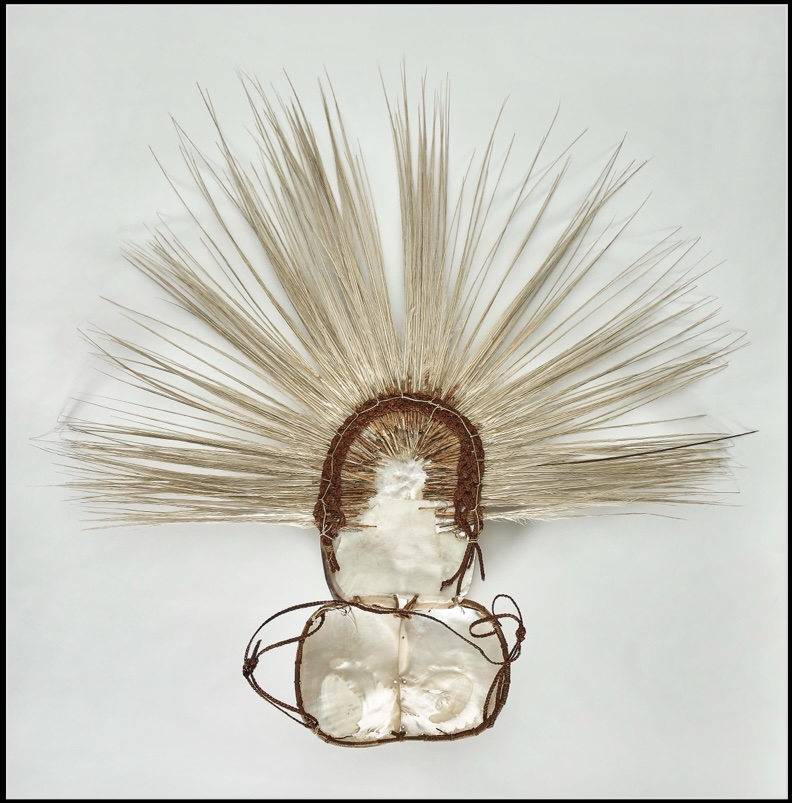
'Silver White Fan Mask,' from Mourner's Costume. Tahiti 1774.
This mask forms part of a full costume acquired by Cook in Tahiti in May 1774 during the second voyage (1772-1775) in HMS Resolution. At this time Tahitian chiefs agreed to receive sacred red feathers from his earlier visit to the island of Tonga in exchange for the mourner's costume. The costume was worn in an elaborate funeral ceremony by the 'chief mourner’, and made up of exceptionally valuable elements: tropical bird feathers, a shell face mask above a wooden crescent upon which pearl shells were mounted, a chest apron of intricately cut and drilled pearl shell strips, together with a barkcloth turban and a layered barkcloth cloak or wrapping bearing distinct dyes and patterns, in some instances bearing a spotted pattern made up of stamped human blood. Cook and Banks witnessed the ceremony, heiva tupapa’u, and were astonished by it.
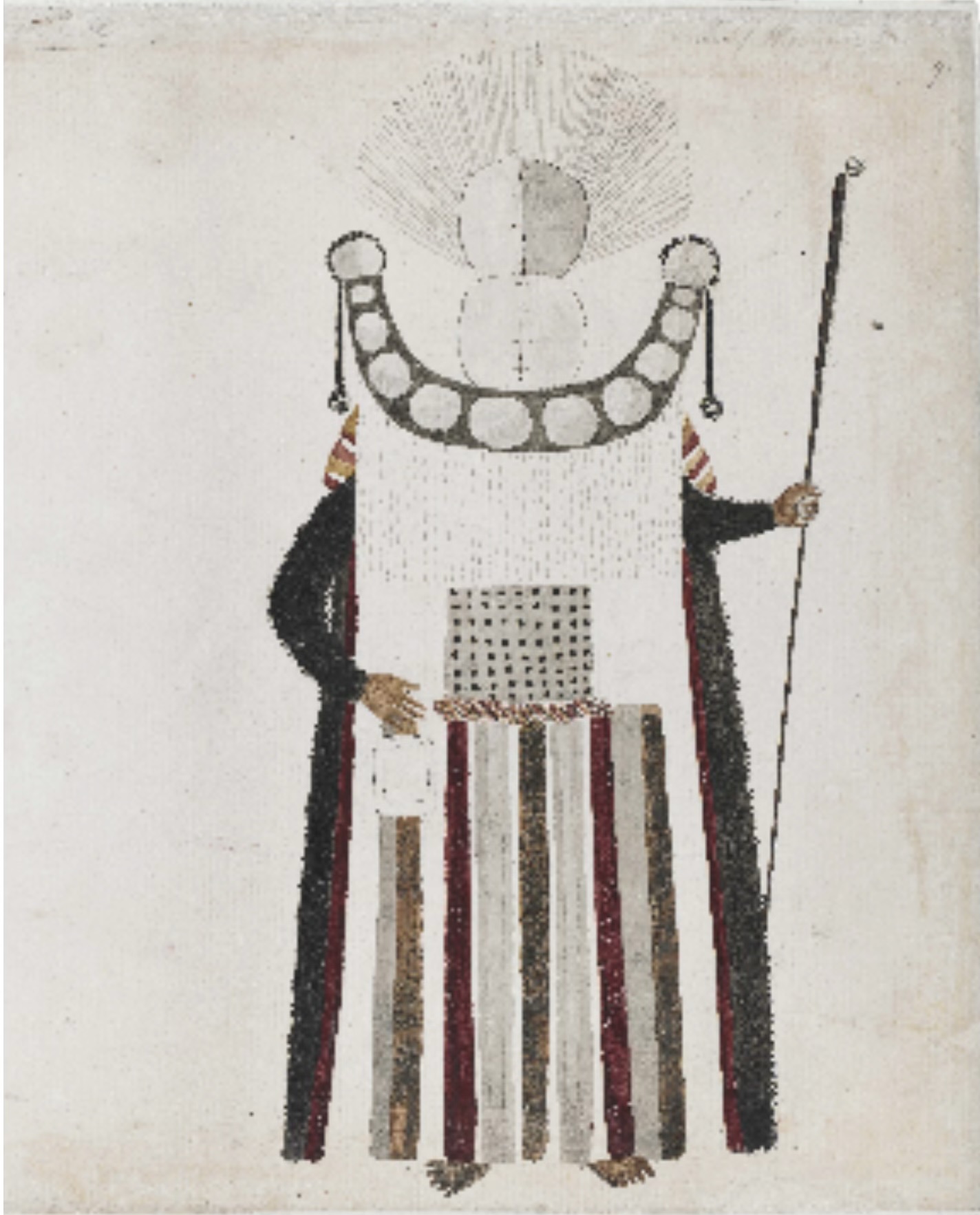
'Mourner’s Costume'. Drawing by Cook's Tahitian navigator, Tupaia.
It is believed that Parkinson met the unnamed Māori man pictured below when he came onboard the Endeavour to trade. The artist Sydney Parkinson was a Quaker and possibly the most compassionate and culturally sensitive of Cook’s men. In this rendition of this warrior, he manages to provoke both wonder and empathy in the viewer. The high angle point of view of this portrait makes the man seem like an exotic creature, a kind of Caliban image looking up from beneath the viewer, but the alert intelligence is there, too. The extraordinary artistry of both outfit and tattoos suggests a sophisticated culture. Parkinson made a series of portraits of Māori individuals, the first images showing the physiognomy, tattoo patterning, dress and ornament of the Māori to reach Europe.
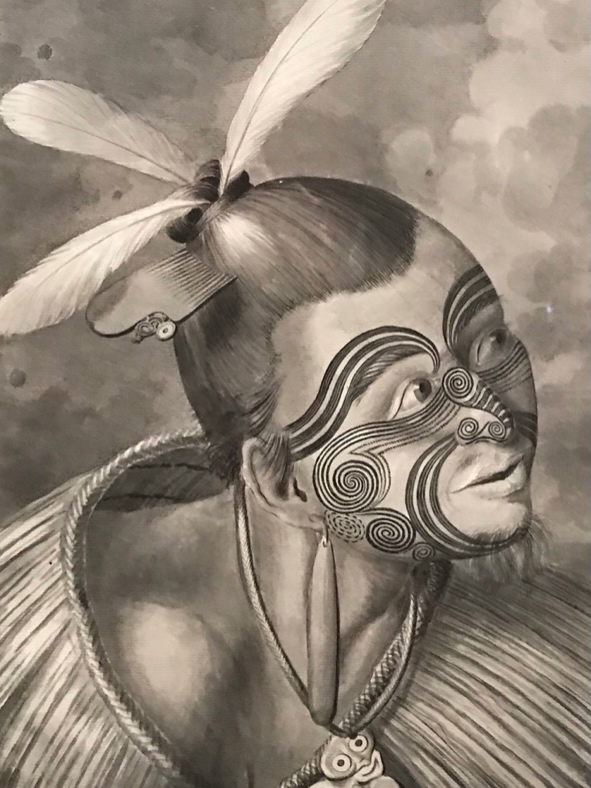
Portrait of Unnamed Māori Warrior. Sydney Parkinson, 1773 (publication date).
On the return voyage, Parkinson died of dysentery from drinking tainted water in the famously pestilential Dutch colonial port of Batavia (modern Jakarta). His journal survived and became an important independent account of the voyage. Cook, a meticulous man who needed to be in control of everything, had managed before then to keep all of his crew alive and free of scurvy for two and half years (a record unheard of in the Royal Navy in the 18th century). He was devastated by the loss of a third of his crew, twenty-seven souls, between the visit to Batavia and the return to London.
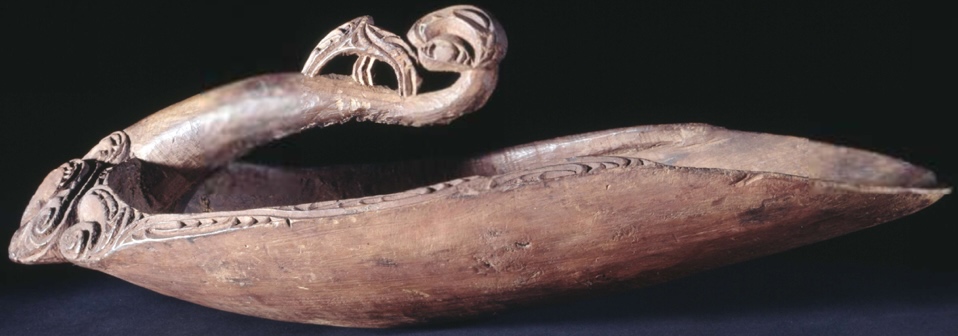
Māori Canoe Bailer (tiheru). 18th century.
CULTURAL COMMUNICATION THROUGH EXCHANGE OF TOOLS
The extraordinary object above, appearing almost alive, is a carved wooden canoe bailer from the north island of New Zealand (Niu Tirani). Anyone who has ever had to bail out a boat in open water will appreciate the way this tool is designed for maximum efficiency and economy of movement. It is likely that the sailor who acquired this object, perhaps Cook himself, appreciated its excellence.
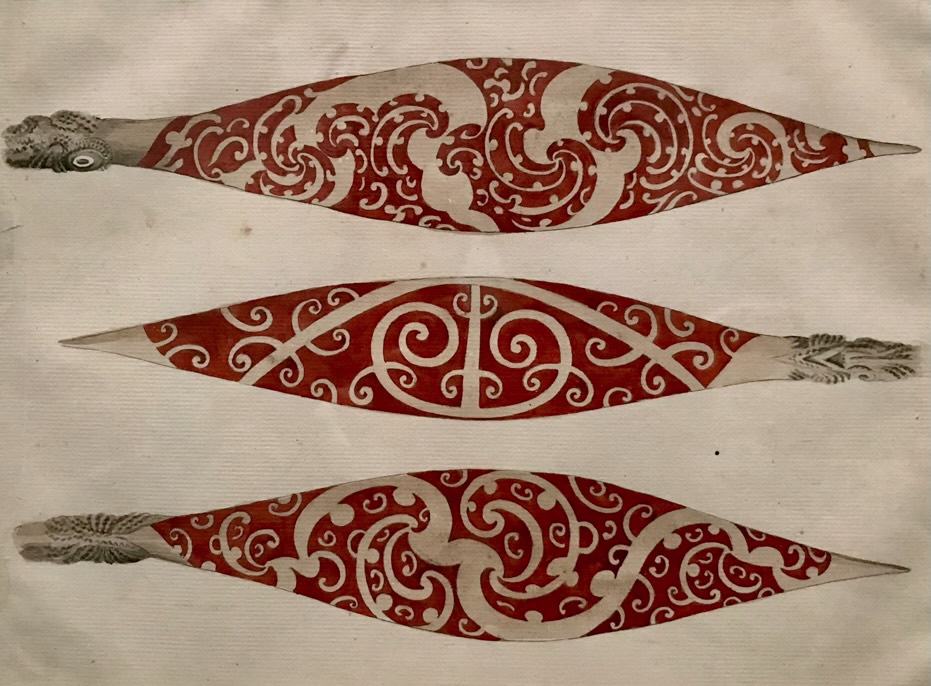
'Decorated Paddles.' Sydney Parkinson, New Zealand, 1760.
As they sailed out of Poverty Bay, a canoe chased the ship, inviting them to return. During this encounter, a set of splendid carved paddles painted with scarlet spirals was presented to the visitors. Sydney Parkinson made a drawing and described them in his journal as ‘curiously stained with a red colour, disposed into various strange figures and the whole together was no contemptible workmanship.’
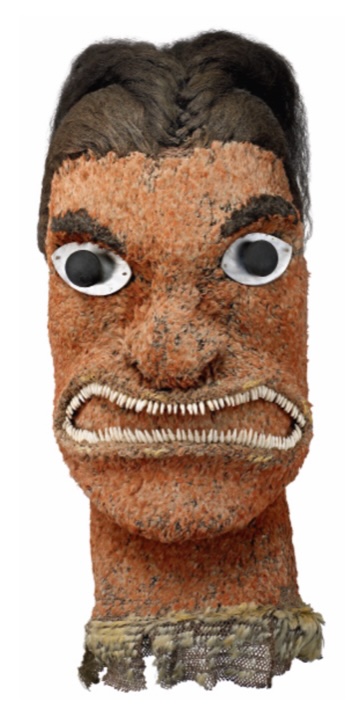
Akua hulu manu, feathered god image, probably Ku the god of war, late 18th century. Hawai'ian Islands. Fibre frame, human hair, pearl shell, seeds, dog teeth, feathers.
Feathered god images like the one above were gifted to Captain Cook by Kalani‘ōpu‘u, paramount chief of the island of Hawai‘i, in January 1779 in extraordinary ceremonial circumstances associated with the god Lono. As the curators of the ‘Oceania’ exhibition explain
In the early decades of encounter, cross-cultural gifts were made strategically. Ambitious chiefs presented works bearing extraordinary spiritual power to visitors [especially well-armed uninvited intruders] such as Captain Cook. These gifts were not expressions of obeisance but efforts to shape relationships with people who appeared, suddenly, from beyond the worlds known to Islanders. They aimed to bring evidently powerful, potentially dangerous strangers into the web of engagements and obligations that constituted Islanders’ lives. (“Oceania”, Royal Academy of Arts , London 2018.)
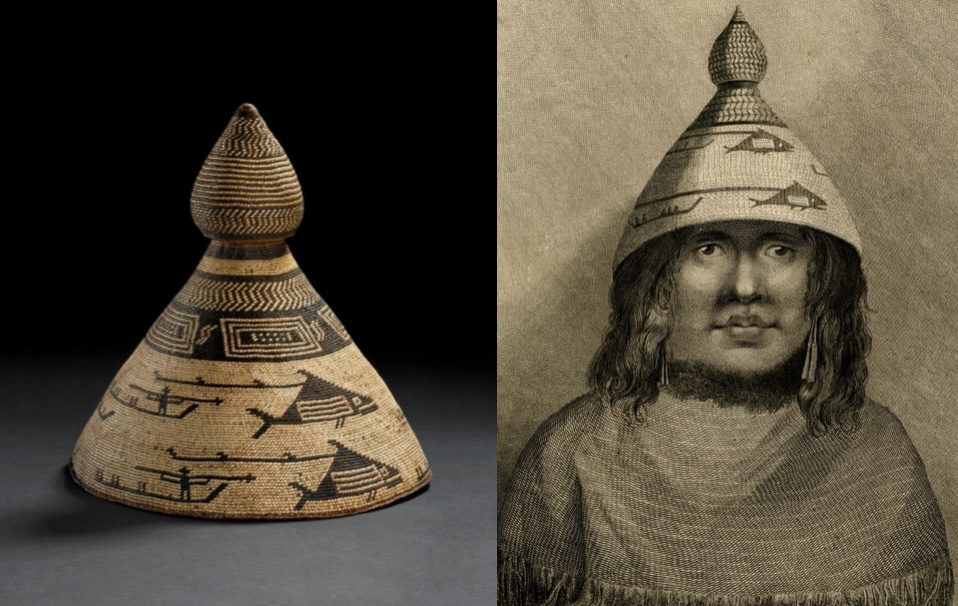
Nuu-chah-nulth hat, Nootka Sound, late 18th century. Nuu-chah-nulth Woman of Nootka Sound, drawing by John Webber, 1784 (publication date).
The British Museum notes suggest that this is a chief’s hat, possibly collected by Cook himself. It was traded with the Nuu-chah-nulth people at Nootka sound off the west coast of what became Vancouver Island (later named after Cook’s fellow officer on the Resolution, George Vancouver). Though this hat did belong to a chief, we also have this wonderful drawing, made from life, of a woman wearing an almost identical hat, woven from dyed cedar root.
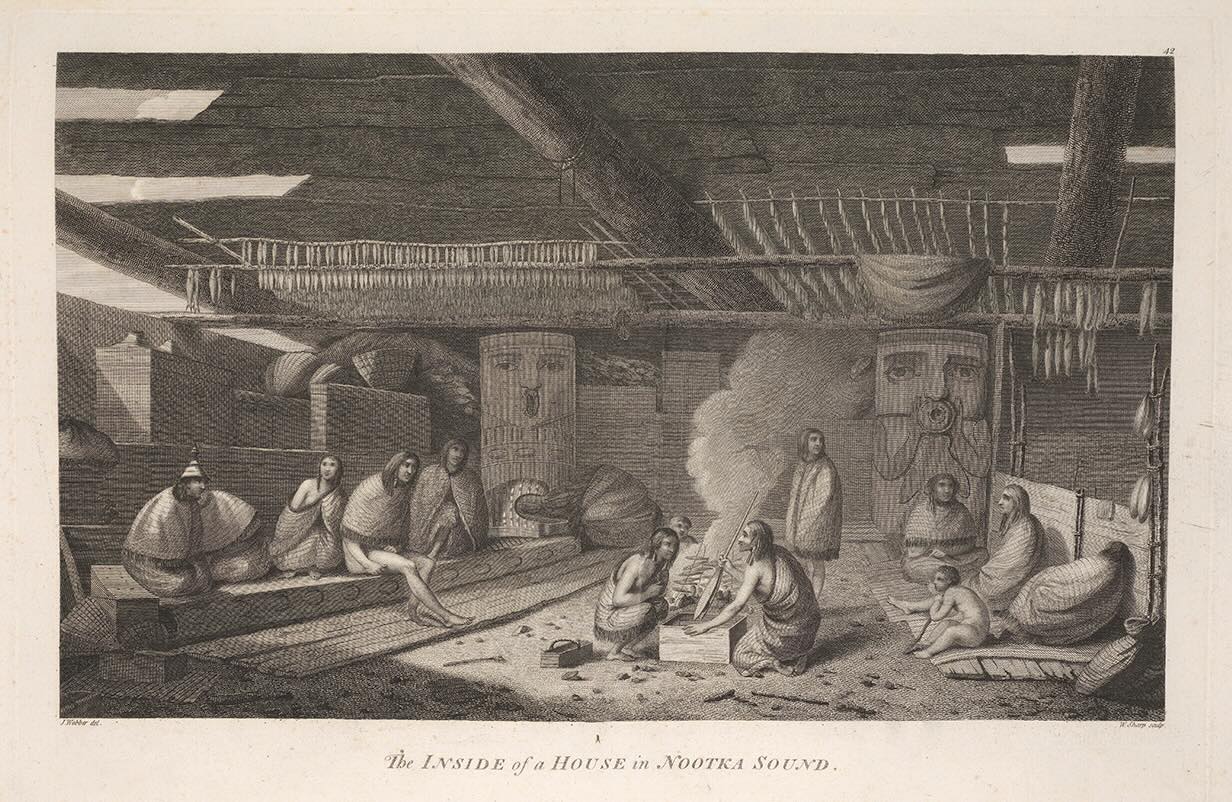
'The Interior of a House in Nootka Sound.' John Webber, 1784.
John Webber was the artist on Cook’s third voyage. In his drawings he offered a wealth of ethnographic detail about the life of abundance and comfort enjoyed by the Mowachaht, who spent the summers on Nootka island, a place they described to be “where the wind blows from many directions.” They lived in massive timber houses made of straight planks, recognizable to any European. When Cook arrived there in 1778 he established cordial relations with Chief Maquinna, initiating a new era of regional power dynamics among the Indigenous peoples. After realizing that Cook’s men were extremely interested in trading for the sea otter cloaks worn by his people, Maquinna became a key figure in the Northwest sea otter fur trade. With the publication of Cook’s account of otters (“as plentiful as blackberries”) in 1784, waves of commercial traders, mostly American, came to the region in the frenzy to trade sea otter pelts to the Chinese aristocracy at a huge profit. Five years after Cook’s visit, Maquinna survived being betrayed by traders and blown up by gunpowder, and several years later his warriors slaughtered the crew of an American ship in retaliation for many other murderous attacks and thefts. Within a few decades, greed on both sides led to the near-extinction of the sea otter.
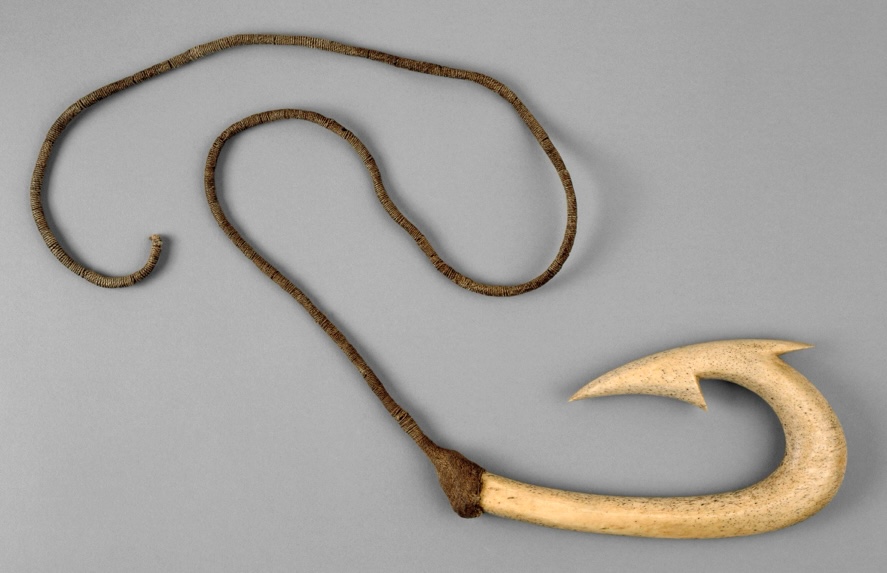
Fish Hook (makau). Hawaiian, 18th century (before 1780). Carved two-barbed shark fish-hook of bone, twine, bound by olona fibre cord.
Hawai'ian chiefs were called 'sharks that walk on the land', and Cook was understood by the Hawai'ians to be one himself, a semi-divine high chief embodying and enacting the role of their powerful seasonal god Lono. Both chiefs and sharks possessed enormous power and close connections to the gods. Shark fishing with hooks was the elite preserve of chiefs. When Captain Cook and his crew — the first Europeans to land in Hawai'i — arrived in 1778, the Hawai'ians traded for goods and gave high-class gifts. This bone hook appears to have been one of them. It was brought back to London after Cook was killed in Hawai’i.
§
When I first came across Cook’s collection in the British Museum 40 years ago, I felt an uncanny sense of being a witness to the testimony of ghosts on both sides — between Indigenous peoples and imperial agents of exploration for new economic and cultural knowledge. These strange exchanges of tribute or trade were acquisitive and dignified for both parties, yet not without a significant tension and the potential for misunderstanding and violence close to the surface.
Cook exhibited a great deal of effort to achieve mutual understanding and respect, and gestures of friendship and generosity occurred on both sides for many of these encounters. However, in addition to the usual trinkets and trade goods, Cook’s men brought the racist and ethnocentric prejudices of 18th century Britain, leaving, among other things, gonnorrhea and syphilis everywhere they went. As we shall see in the next two parts of this series, Cook carried enlightenment ideas of justice and and mutual respect along with greed and colonial ambition. The clash of cultures exposed vast chasms of ignorance, misunderstandings, and fatal errors that continue to reverberate, particularly for the peoples of the Pacific. ≈ç
REFERENCES
- Brunt, Peter and Thomas, Nicholas.“Oceania” exhibition catalogue, Royal Academy of Arts, London 2018.
- Dening, Greg. Mr Bligh’s Bad Language. New York: Cambridge University Press 1992.
- Frame, William and Walker, Laura. James Cook: The Voyages. London: British Library 2018.
- Mallon, Sean. “Collections, Access and Collaboration.” “Oceania” exhibition catalogue, Royal Academy of Arts, London 2018.
- Moore, Peter. Endeavour: The Ship That Changed the World. New York: Picador 2018.
- Sahlins, Marshall. Islands of History. Chicago: University of Chicago Press 1985.
- Salmond, Anne. "Was James Cook a white supremacist?" 2019.
- Salmond, Anne. “Reimagining The Ocean”,“Oceania” exhibition catalogue, Royal Academy of Arts, London 2018.
- Dame Anne Salmond interviewed by Alan Macfarlane, November 19, 2004.
- Turnbull, David. “(En)countering Knowledge Traditions: The Story of Cook and Tupaia.” in Science, Empire and the European Exploration of the Pacific. London: Routledge 1994.
- Vaillant, John. The Golden Spruce. Toronto: Random House 2005.
- Wikipedia.org/wiki/James_Cook

CHRIS LOWRY is a media producer and frequent contributor to Wild Culture. His most recent award-winning documentary feature film is Rebel Angel (2022), about the Canadian cultural figures, Ross and Marion Woodman. He lives in Toronto where he performs regularly with his band, The Cool Blue North. View Chris' website.
IMAGE CREDITS. We thank the Trustees of the British Museum for the opportunity to use these images under our Creative Commons 4.0 International licence.
Comments
Fascinating article. I know…
Fascinating article. I know little of Cook (except for what I have seen on my many trips to Sydney) and in particular had no idea of the role he played at Louisbourg and the Plains of Abraham. You have sent me down a rabbit hole of Wikipedia entries! I eagerly await the next instalments.
— Guy Beaudin
Thank you for an…
Thank you for an extraordinary well researched and thought-provoking — and, thank goodness, balanced — approach to the topic of Cook. I very much look forward to reading your second and third episode episodes that follow onwards from:
“Cook carried enlightenment ideas of justice and and mutual respect along with greed and colonial ambition. The clash of cultures exposed vast chasms of ignorance, misunderstandings, and fatal errors that continue to reverberate, particularly for the peoples of the Pacific.”
— Kim Galvez
Add new comment