
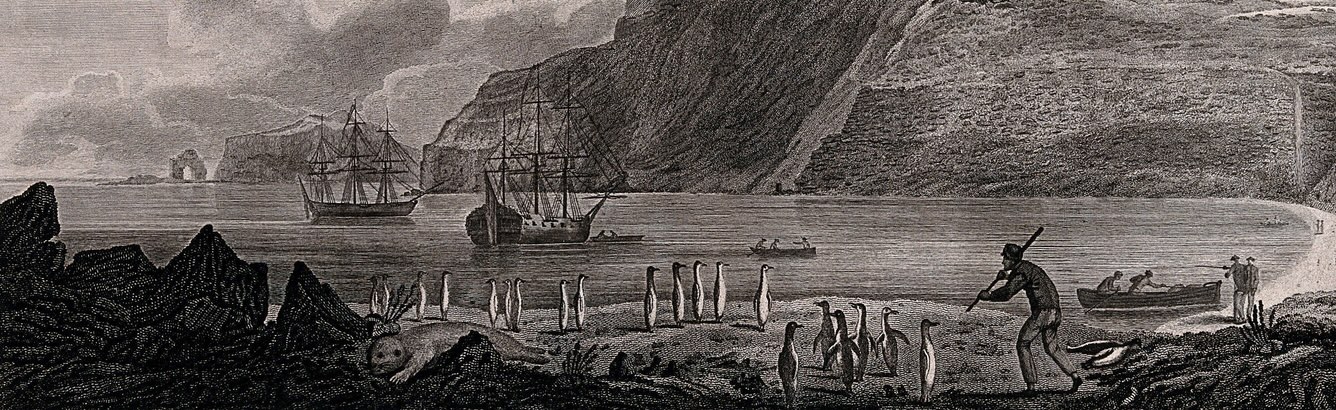
Christmas Harbour in Kerguelen Island (South Indian Ocean), Captain Cook's ships Resolution and Discovery in the bay. Engraving by J. Newton, 1784, after J. Webber.
The first two essays in this series about Captain James Cook took us away from our own familiar shores into the world of this 18th century British mariner and his ‘first contact’ encounters with the peoples of the vast uncharted Pacific. This essay will dive deeper into the life of this exemplary yet enigmatic character and his long, strange trips. Cook’s tale is a grand adventure, to be sure, but it is also the story of a leader beset by hardship, bad faith and the tricks of fate. He was a man who became deified, who was caught up in cultural and cosmological imperatives only dimly understood — a character like Odysseus who rode, to his death, whirlwinds both actual and mythic.
With a sharp mind and wide-ranging skills as a navigator, cartographer, self-taught ethnographer and diplomat, Cook saw himself setting an example of how to be a humane and non-violent explorer.1 As an apprentice to a Quaker sea captain (and living in his household for eight years), Cook had absorbed the egalitarian ideals of the Society of Friends, sober pacifists who abhorred slavery and advocated social justice. This must have been a source of some inner struggle for him when he joined the Royal Navy at the age of twenty-six, with its culture of rank, harsh discipline and military aggression.
Haunted by exotic memories and goaded by ambition, he was compelled to set out to those marvellous, treacherous places where he was both beloved and feared.
Though sympathetic to pacifism, Cook was a soldier who fought in Canada during the Seven Years' War, and through this period he was honoured to receive the patronage of men like Vice Admiral Hugh Palliser. Palliser had known him in action performing astonishing feats of mapping in the St. Lawrence River that enabled the triumphant siege of Quebec under the command of James Wolfe. Driven by relentless ambition, Cook chose to be a man of his time, with its imperatives of conquest and Christian hegemony, but in his style of command and exploration he showed himself to be an idealist — even a humanitarian. The reader may judge whether or not Cook should be remembered alongside the most empathic of the Europeans who ventured forth to the New World, men like Alvaro Nuñez Cabeza de Vaca, Bartholmé de las Casas, Samuel de Champlain, Alexander von Humboldt and David Thompson.
Of Cook’s three voyages in the Pacific, his second (1772-75) took a heavy toll on his physical and mental health. In his determination to fulfill his mission and to look for resources to exploit beyond the known world, Cook led his men on a remarkable odyssey — from the treacherous iceberg fields of the southern ocean to the enigmatic stone heads on the treeless hills of Easter Island, to the rich culture and abundance of the Tongan archipelago and Tahiti. Cook and his well-seasoned crew were at sea for three long years, covering over 20,000 leagues of ocean (equal to three times around the globe), much of it uncharted by Europeans.2
In many places the natives were hostile; resisting these strangers they thought to be powerful ancestral ghosts from another world, brandishing bizarre weapons and firing warning shots of thunder. The aim here was to intimidate rather than to shoot the natives when they did not immediately lay down their arms. Cook’s men thought he was far too lenient. Despite strict orders to hold their fire unless fired upon, his officers and men, and on occasion Cook himself, exchanged fire and killed aggressive men in the Marquesas, the New Hebrides, Tonga, New Caledonia and even in their beloved Tahiti.3 Cook’s involvement in the cultures of Polynesia deepened with each new encounter, and he suffered both anguish and anger when these meetings came to blows. He felt bound to honour his original instructions from the Earl of Morton to respect native rights, and the Quaker philosophy that he had absorbed as an apprentice with John Walker in Whitby had kindness and empathy at its core. The journal of Zimmerman, one of the men on his third voyage, describes this dynamic
[He] was born to deal with savages and he was never
happier than in association with them. He loved them and
understood the languages of the different islanders and
had the art of captivating them with his engaging manner.
This was probably the reason that they honoured and at
times even worshipped him, and also further reason that
when they ceased to honour him, or sometimes even
ridiculed him, he burned with rage. 4
Returning to England from the second voyage after such a long absence, Cook received a hero’s welcome. He became a fellow of the Royal Society in recognition of his contributions to medicine, cartography, ethnography and astronomy.5 Meanwhile, the King initiated plans to send an expedition back to Tahiti to return Mai, the young Tahitian traveller, to his home. Consulting frequently with Cook about the plan, the Admiralty and the Royal Society then proposed that, after Tahiti, the expedition should pursue the other great navigational mystery of the age, to seek a Northwest Passage across the uncharted north of America from the Pacific side. Cook, though officially retired, was intrigued.6
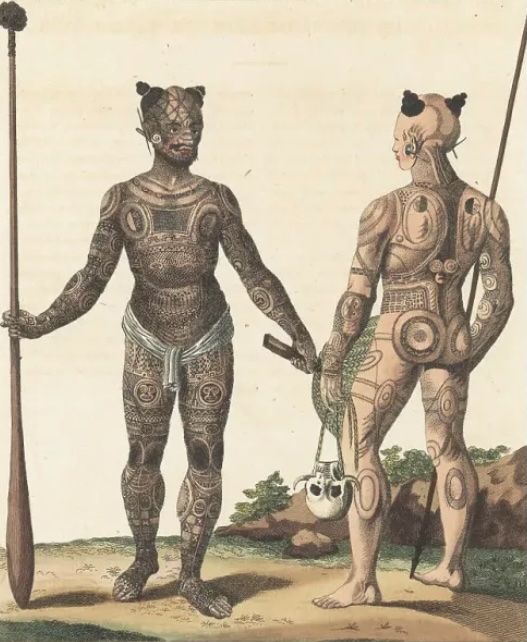
Full body tattoos of Marquesan warriors. Cook visited the Marquesa Islands to get food and water on his second voyage. [o]
Initially, the voyage was assigned to Charles Clerke, an extroverted and sharp-witted young officer who had proven his worth on Cook’s first two voyages, and now looked forward to his own command. However, the First Lord of the Admiralty, the Earl of Sandwich — who was also Cook’s friend and patron — deliberately involved Cook in the planning in the hope that Cook would rise to the bait. Everyone understood that Cook deserved to enjoy retirement — to settle into an honorary paid position at the Royal Hospital for Seamen at Greenwich — but some suspected that such an easy sunset was not in his nature. During the course of a long dinner at Admiralty House in London, Cook was drawn into a discussion of what appeared to be a golden opportunity — the chance to reach for new uncharted waters in the Western Arctic. He got so excited that he stood up and declared, to the delight of his friends, that he would lead the mission himself. As his first biographer Kippis put it, Cook could see “the grandeur and dignity …[that] the completion of it would give to the whole system of discoveries.”7 He may have been relieved to have survived and proud to be recognized for his achievements — indeed, he was world famous — but he chose in that moment to give up a comfortable retirement with his wife and children around a cozy hearth. Despite being worn out and in ill health Cook was drawn back toward the lands of the Pacific where he was revered as a high chief, a demi-god. Perhaps haunted by exotic memories and goaded by ambition, he was compelled to set out on a third voyage to those marvellous, treacherous places where he was both beloved and feared.
The HMS Resolution had served Cook well on his second voyage but, unbeknownst to him, she had recently been refitted poorly with inferior masts and badly caulked by corrupt contractors in the Deptford shipyard. They were under pressure from the Admiralty to overhaul and outfit troop transport ships destined for America, as this was the beginning of the so-called American rebellion (1776). Cook would soon learn at sea that the ship was very leaky and uncomfortably damp in the sailors’ quarters below decks.8
Sure of the main objective — to seek the Northwest Passage to open a new sea route to the Orient from the western side of America — his orders were cumbersome. First, before he could head north to engage in his primary mission, he was required to bring the celebrated young Tahitian man Mai, who had been richly enjoying the patronage of Joseph Banks and all the pleasures that King George and the elite of London could offer him, back to Tahiti. More than just Mai and his extensive luggage, toys and guns, the King insisted that Cook must bring a veritable Noah’s Ark of livestock as gifts for Tu, the current high chief of Tahiti. This went against Cook’s deeply held convictions about cleanliness and health on board. The stench, the noise, not to mention the care and feeding of a menagerie that included Mai’s two horses, cattle, goats, sheep, chickens, peacocks, geese, rabbits and turkeys caused Cook great anxiety all the way to Tahiti. Though he acquiesced to the King’s wishes, Cook wrote that “the trouble and vexation that attended bringing these animals this far is hardly to be conceived.”9
As they set out, the captain appeared to his men to be restless, weary and unwell. Approaching his fiftieth year, the stress of his monumental career had worn him out. He was suffering from a number of ailments, including painful sciatica and ongoing serious bowel problems. Early in the voyage off the Cape Verde Islands he narrowly averted shipwreck, an incident of uncharacteristic bad judgement that disturbed his officers. As one biographer, Gascoigne, put it, the Resolution was “a tired ship commanded by a tired man.”10 Captain Clerke was also sickly, and would weaken from tuberculosis as the voyage went on.
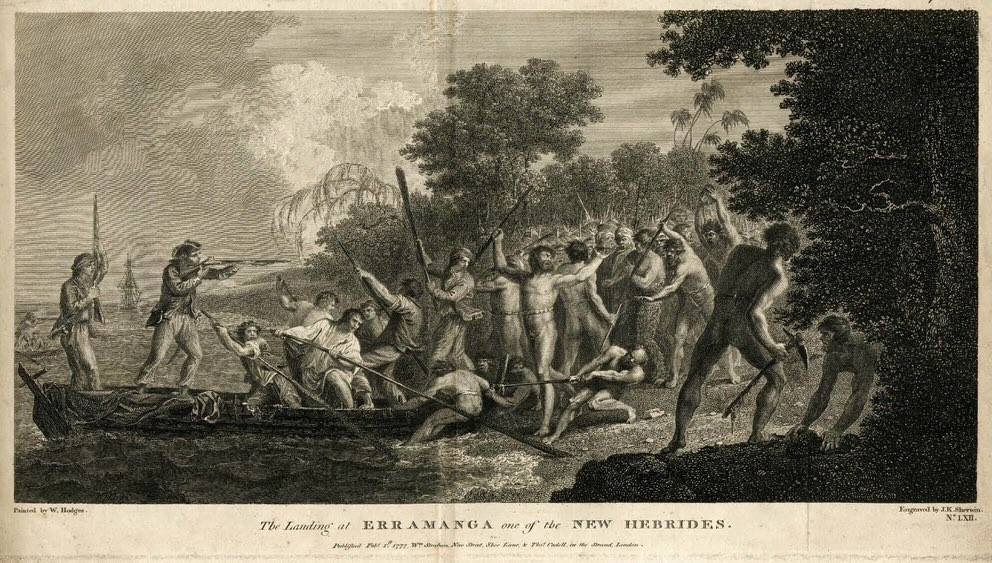
The Landing at Erramanga, one of the New Hebrides, an etching by William Hodges,1792. One of several landings that began or ended in hostilities.
Heading for Tierra del Fuego at the southern tip of the Americas, the ships met contrary winds and were driven back across the Atlantic toward the Cape of Good Hope at the bottom of Africa. Cook was aiming for New Zealand to investigate a terrible incident that had happened without his knowledge on his previous voyage involving his consort ship, the Adventure. It may well have been on his mind when he accepted the offer to lead this third expedition. Now that destiny and the Admiralty had given him another shot at Polynesia, he was determined to seek answers.
Back in October 1773 the Adventure became separated from Cook’s Resolution in severe storms off New Zealand. After some weeks the captain, Tobias Furneaux, arrived for the rendezvous in Ship Cove, only to find a message in a bottle from Cook, dated just six days before, saying he had waited long enough and they would likely not meet again on the voyage. From past experience the British assumed they were welcome on shore, but the fiercely territorial Māori seemed unhappy to see more foreigners arriving on their land. As Furneaux’s men settled in to make repairs and secure provisions, tensions mounted. At night the sentries saw silhouettes of canoes offshore; crouching figures appeared and disappeared in the moonlight. There were thefts of tools from inside the tents. Muskets were fired, and one morning a trail of blood indicated that one of the raiding party had been wounded by a shot in the dark. That night a large meteor burned across the sky, increasing the sense of foreboding among the sailors. After two tense weeks, while making hasty preparations to leave, Furneaux sent a boatload of ten men ashore in their cutter (a fast, single-masted sailboat) to gather some wild greens to supplement their diet. The men never came back. A search party discovered clothing, a hand and other body parts, and realized that their comrades had become part of a sacred ceremony and war feast according to the traditions of the Māori. Further down the shore a throng of hundreds of people were enjoying a celebration. When Furneaux’s men dispersed the crowd with gunfire they came upon the place of the butchering, Grass Cove. Body parts and organs were scattered around. Lieutenant Burney described it as a “shocking scene of carnage.”11 Threatened with attack, the Englishmen escaped to their ship and departed in the morning. When Furneaux got back to England ahead of Cook seven months later, his tale of the cannibal savages shocked the world.
Cook only heard the news in March of the following year when he passed back through South Africa on his way home. He was deeply troubled by it, yet was reluctant to blame the Māori without finding out if some provocation had led to the conflict — even if he was the only man in England who cared to know their side of the story. “I have always found them of a brave, noble, open and benevolent disposition,” he wrote. “But they are a people who will never put up with an insult if they have an opportunity to resent it.”12
To conduct an inquiry of his own, Cook returned to Queen Charlotte Sound (Tōtaranui) on the north end of New Zealand’s South Island in February 1777. This was a personal matter for him. He was under no obligation to the Admiralty to see if Furneaux’s men had provoked the massacre. When Cook approached the Māori, having not seen them for over two years, they were reluctant to engage, fearing that he had come for vengeance — as they would expect any adversary to do. Their sense of reciprocity was exacting. “In matters of warfare, a death must be avenged by another death, It was not only expected, it was required.”13 To kill and ceremonially eat members of another group was the most extreme insult, “biting the head” of their ancestors. A true rangatira (leader) must retaliate an eye for an eye, lest his gods withdraw their support, leaving both leader and people without ‘mana’, their capacity to act effectively in the world. But when Cook’s inquiry led him to understand that the highly racist leader of the boat crew that Furneaux had sent to collect wild greens, Rowe, had drawn the first blood — had rashly shot two men for the theft of some pieces of bread — Cook decided that nothing would be gained by punishing the killers for their justifiable reaction. Most of Cook’s crew, including the Tahitian translator Mai, were enraged and bewildered when Cook refused to execute the leader of the massacre, Kahura, who was a Ngāti Kuia and Rangitāne chief. When Cook, with his deep sense of diplomacy and peace-making, invited Kahura into his cabin, Mai shouted at him “There is Kahura. Kill him! If a man kills another in England, he is hanged for it. This man killed ten and yet you will not kill him.”14 Neither Mai nor Cook’s men understood his reasoning. It was grounded in an understanding of the cascade effect of retaliatory killings that he feared to unleash due to what, he believed, had been Rowe’s transgression and Kahura’s righteous revenge.15
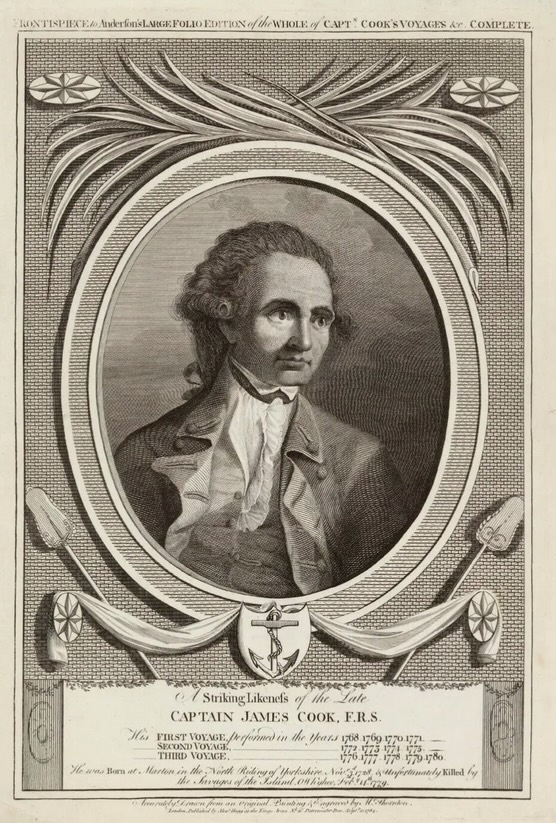
James Cook, by Thornton, after Unknown artist, line engraving, 1784.
The whole Grass Cove affair left Cook feeling bitter. He remembered that when he circled back to New Zealand on his second voyage, the Māori he trusted had failed to inform him of the massacre; they had deceived him and trust was broken. Now, his crew were angry with him for being too lenient with the natives, while resenting how he had become much more authoritarian with his own men. His use of the lash on sailors and marines for minor infractions had become commonplace on board ship. At the same time, he realized that his tolerance was seen as weakness by the Māori; it was a lose-lose situation.
At this juncture in the voyage Cook may have experienced disillusionment that led to an existential crisis of his faith in the value of cross-cultural exchange. “We debauch their morals,” he wrote, “and we introduce among them wants and diseases which they never before knew.” He reflected that his involvement with the Māori — bringing the prejudice, ignorance, appetites and infections of his people with him along with their curiosity — “serve[d] only to disturb that…tranquility they and their forefathers had enjoyed. If anyone denies the truth of this assertion, let him tell me what the natives of the whole extent of America have gained by the commerce they have had with Europeans.”16
For his part Cook felt a rupture in his world view and way of being. He cherished his gift for establishing trust; it was his primary currency both as a commander of a ship and in his encounters with these unknown peoples. This was at the core of his character. The sense of being both betrayed and misunderstood by the Māori, and of being distrusted and disrespected by his shipmates, shook him deeply and changed him. This was perhaps the worst of the many incidents where this wise man’s best judgement proved inadequate to the subtleties of hidden prejudice and cultural habits in both the Polynesians and his own men. Cook, a decisive and intuitive navigator of the physical world, found himself at a loss to understand the deeper motives in the hearts of men, with dire consequences.
§
Cook returned Mai to his homeland in Tahiti and delivered his ark-load of livestock to the wonder and bemusement of chief Tu and his people. The captain was celebrated with the high honours accorded to a chief with the aura of divine right and potency. Meanwhile, his men enjoyed the favours freely offered by the women who sought to join their spirits (varua) with the extraordinary white strangers to gain both stature and precious goods in the act of love (red feathers and iron nails were valued gifts). When his hosts noticed signs of Cook’s chronic pain, Cook himself was persuaded to submit to the kindness of women, though not for sex. He was immersed in the wonders of lomi lomi, the Tahitian form of full body massage administered to him by seven women skilled in this ancient form of healing. Afterward he pronounced his sciatic hip and leg pains “entirely removed.”17
As he left Tahiti Cook pointed the ships northwestward, expecting open ocean all the way to America. He may have had an inkling, based on a Spanish chart captured by Anson in 1743, that there might be a cluster of volcanic islands out there. It seems likely that he knew about that cartographic rumour and may well have aimed to see for himself. Sure enough, they sailed straight toward the Hawaiian island of Kaua’i, a gorgeous green volcanic marvel with cliffs rising to a 5,000-foot summit.
In the moment of greatest danger, he was at once the most merry, the most serene, the most steady.
They were greeted by muscular and handsome warriors in canoes who were unafraid to threaten the ships with rocks, spears and lewd gestures. Astonishingly, the Hawaiians understood the questions shouted by sailors in pidgin Tahitian, and eventually interacted peacefully with the strangers. They speculated that these must be gods or sorcerers with such strange extensions on their bodies (smoking pipes, tricorn hats). Though Cook had published orders forbidding intercourse with the local women, some liaisons and infections did occur in secret, as the erotic gestures of invitation from the women were unmistakeable. Enthusiastic trade was conducted until an impetuous officer, Williamson, who declared that the “insolence” of “savages” should be best controlled with the example of “execution,” shot and killed a man for trying to grab hold a boat hook, likely in an effort to help the visitors land in the surf.
When Cook came ashore, not knowing about the “execution”, he was met by a crowd of hundreds of people who fell with their faces to the sand. Cook laughed, not knowing that this was kapu moe, the gesture of obeisance accorded to the highest chiefs (alii) who exercised the power of the gods among men. Other rules of kapu included the segregation of men and women at meals, and some food restrictions for women. Violations of kapu were punished by death.
The island of Kaua’i appeared to the sailors to be a radiant new paradise full of graceful, joyful and sensual people. They sang beautifully and often. Almost everyone enjoyed personal adornment with bracelets, necklaces, amulets. The bare-breasted women wore short colourful skirts and sometimes wreaths of flowers on their heads, a flower behind one ear. Men and women bathed frequently and applied fragrant oil to their bodies.18 They were Polynesian yet also unique. Unlike Tahitians, they had no experience of Europeans. This was first contact. Significantly, it was a warrior culture, with a palpable tension and fearsome weaponry suggesting, as in the Society Islands and also back in New Zealand, that they might be at war with neighbouring groups. Cook soon felt at ease and allowed himself to be guided into the interior of the island unarmed and without guards, accompanied by large crowds who bowed low when he looked their way.19
Back on the beach Cook saw that the winds and currents were shifting the Resolution from its anchorage and he decided it was time to go. Anchored in a more protected bay, the Discovery, under Clerke’s command, lingered off shore for another day. Clerke was able to meet with an important young chief, Kaneoneo, who presented him with a remarkable two-headed kava bowl with mother of pearl inlaid faces, now in the British Museum. Cook later recorded in his journal that a chief of great sanctity sought out Clerke to present to him “a large Cava bowl, that was supported by two carved men, neither ill-designed nor executed.”20 Kava is a psychoactive plant, Piper methysticum. When mashed and blended as a drink, it has soothing and calming effects. It was considered a highly sacred beverage strictly reserved for royalty, chiefs, and religious leaders (kāhuna). Thus for Kaneoneo the gift was a gesture to acknowledge that, by their appearance — their astonishing vessels, their magical weapons and their pale skin — the strangers commanded the tribute due to powerful adversaries.
Leaving the rest of the Hawaiian chain of islands without further exploration, Cook directed the ships northwest again through unknown waters, arriving in severe storms off the coast of Oregon in March 1778. Wind, rain and fog kept them out at sea all the way up the coast past the Straits of Juan de Fuca until they found safe harbour off Vancouver Island — what Cook named Nootka Sound (named because the natives had called out “nootka!” meaning ‘go back’ or ‘go around’). After their ships were surrounded by thirty-two cedar canoes full of men with ochre painted faces, noses pierced with bone and wearing animal skins and bark cloaks, a shaman stood up in one of the boats and performed, with great dignity, a ceremony and song to the steady beat of native paddles on gunwales. In response, two musicians on board the Resolution played a haunting melody on their French horns, resonating across the sound to the village, the forest and the mountains. It was an auspicious beginning in this meeting of cultures.
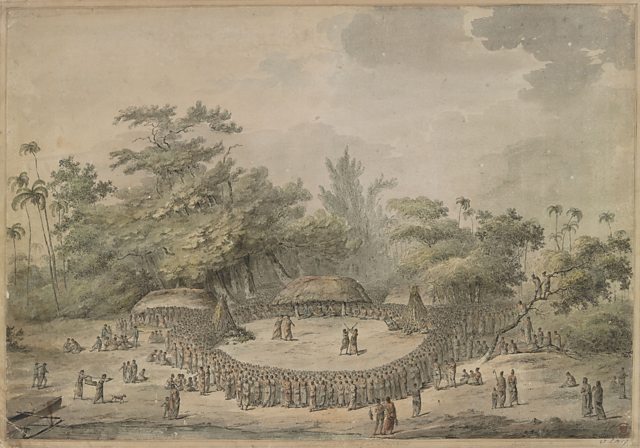
A gathering on the island of Haʻapai (historically spelled Hapaee), part of the Haʻapai group in Tonga (the Friendly Islands), where Cook's expedition visited in May 1777. By John Webber.
Cook’s time among the Mowachaht (“people of the deer”) — described in the first essay of this series — was productive and peaceful. The crew replaced a mast with superb timber from the ancient rainforest, beached and caulked the leaky ships, and conducted a brisk trade which included fine carvings, furs, weapons and, inevitably, sex. The native men were shrewd traders who would sell their women for a price. It may come as a surprise to learn that the Mowachaht also practiced, like the Māori and so many other first nations around the world, the tradition of cooking and eating enemies slain in battle. They offered the sailors human skulls and severed hands of the vanquished to trade. There were also skulls mounted on the bows of canoes, though such macabre details are entirely absent from Canadian museum displays today. By this time Cook had seen the skulls of enemies displayed in many different island cultures. He respected indigenous war traditions to some degree, and had an ethnographic fascination with human sacrifice in Tahiti. Far from disdaining ‘savages,’ he embraced them: “Three things made them our fast friends,” he wrote. “Their own good Natural and benevolent disposition, gentle treatment on our part, and the dread of our fire arms…”21
Cook complained that the local men haggled with him until his pockets were empty. According to the sailor Ledyard, a Mowachaht man got fed up negotiating with Cook and pushed him aside, “pointing the way for him to go about his business.” Apparently Cook had not lost his sense of humour. He turned from this tough Mowachaht trader and remarked with a smile, “This is an American indeed!”22
All repairs and provisioning complete, they set out once again and soon found themselves in the teeth of the most severe hurricane of the voyage. After five days of massive seas in a punishing gale, they came through it without damage or injury. He may have been sick, tired and moody, but here in adversity, the great navigator was at his best. “On the unknown coast of America,” wrote the sailor Zimmerman, “the ships ran of foggy nights under full sail, and the captain slept peacefully all the while. In the moment of greatest danger, he was at once the most merry, the most serene, and the most steady. His main object was to establish a calm state of mind on the ship, and in this he succeeded so well that all eyes were usually turned toward him.”23
Even though the main objective of the voyage, to find the Northwest Passage across the Arctic Ocean, was doomed to failure, Cook’s time in this region was characterized by positive encounters with the local peoples,24 who enjoyed the staggering beauty of their homeland and the most abundant, diverse wildlife imaginable. Sailing into Prince William Sound (where the Exxon Valdez oil tanker foundered on Bligh Reef in 1989), they found themselves in an inland sea fed by two thousand rivers and streams and twenty glaciers from the jagged Chugach mountains. In the sound there were large populations of whales, dolphins, walruses and seals, and massive concentrations of fish including giant halibut. Bald eagles, puffins and gulls filled the skies while predators — bears, wolves and foxes — could be seen on the rocky shores.
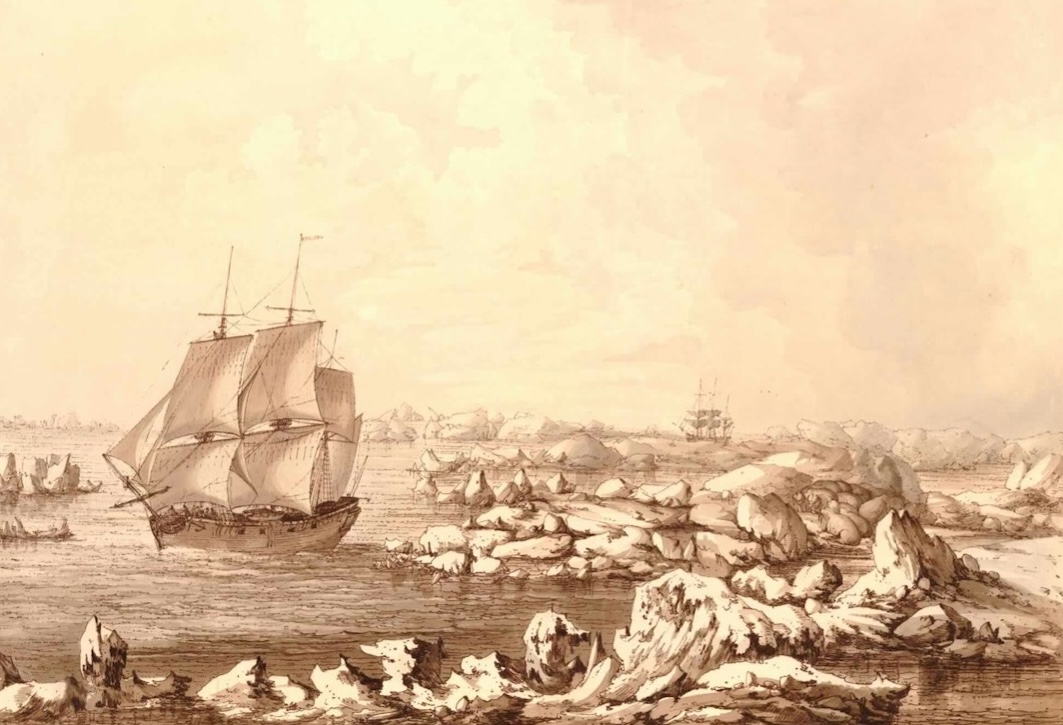
Cook's ship, HMS Resolution, sailing free through a narrow passage of ice floes in the high Arctic, the Discovery in the distance. Etching by John Webber, 1792.
Reaching the westernmost tip of Alaska, the ships squeezed through a narrow passage in the Aleutian chain into the vast Bering Sea. At this point Cook chose, perhaps for his personal bucket list, to make a run further east across the fifty-mile-wide strait, to step ashore in Asia. On shore the Chukchi people met the ships prepared for battle, having faced the wrath of genocidal Cossacks in the past. Cook strode alone and unarmed among the bristling arrows and spears as he had done often throughout the Pacific. He offered a necklace of beads and some tobacco to the elder who approached him. With trust established by eye contact, the tension was broken and over the next few hours Cook and his men explored the settlement.25 Invigorated by the encounter with the Chukchi, Cook described them as “long visaged, stout-made men” who fashioned a complex culture of ingenious tools, garments, images and dwellings almost entirely from the bones and skin of the creatures they hunted.
Often characterized by chroniclers as a journey of relentless frustration blocked by a wall of ice, the voyage north actually turned out to be an exhilarating time with many achievements, including the intense emotion of potential success. Crossing a vast open sea where no European had been before him, Cook was now history’s master of the Pacific and the first captain to cross both the Antarctic and the Arctic circles. One of Cook’s biographers, Richard Hough, wrote that “it was as if they had threaded together the whole world… the secret of the earth’s geography had been revealed to them in this one magic moment of suspension between the continents.”26 They did, however, confront a wall of ice closing in on them and were forced to abandon their eastward quest.
To the chagrin of many on the ships who were sick and tired and doubted the existence of a passage beyond or above the wall of ice, Cook was determined to continue his search the following year in service of Lord Sandwich and British commercial ambitions. However, he did not like the idea of seeking winter anchorage in the Russian port of Petropavlosk. Perhaps he had no love for the Russians, who were trading rivals of the British (a bogus Russian chart provided to him by the Admiralty had misled him in his exploration of the region up to that point). Instead, he delighted his men with the fateful decision to return southward to the Hawaiian Islands, where he would undergo his most complete transformation to semi-divine stature as a Polynesian high chief. It is also where he would meet his death. In the fourth and final essay in this series we will unravel the troubled, tangled circumstances of Cook’s extraordinary life and tragic end in Hawai’i. ≈ç
ENDNOTES
[1] Though lowly of birth, James Cook was noble in the sense that, as a man of rare integrity he gained, by his merit, the favour of the English nobility — peers of the realm such as Sir Joseph Banks and John Montagu, the 4th Earl of Sandwich. The respect of the most powerful men in the Royal Navy ensured that no expense was spared to provision his ships.
[2] Cook’s ship on the second voyage was the sloop HMS Resolution with one hundred and twelve men on board, and his smaller consort ship, commanded by Tobias Furneaux, was the HMS Adventure.
[3] Between Cook’s first and second voyages, there had been trouble in paradise. Tahiti was ravaged in 1772-3 by a series of retaliatory civil wars between rival kinship groups claiming power. Some of Cook’s friends had died, others were brought low, and some warriors Cook encountered in August 1773 were wary, hostile and uncooperative. Nevertheless the land was still exhilarating, and the young girls offered themselves willingly to the sailors and officers.
[4] Salmond, Anne. The Trial of the Cannibal Dog: Captain Cook in the South Seas. Yale University Press, 2003. Among the vast canon of writings about the voyages, the work of New Zealand anthropologist Anne Salmond provides the most messy details of Cook’s trouble and strife, gleaned from close reading of all the crew journals as well as indigenous oral histories. Salmond relates that despite serious incidents of conflict with the people of Tonga whose trust was gained through fear of the strangers and their fire power, Cook called Tonga the Friendly Isles. Repeatedly displays of British force led to friendly, gentle treatment but this could turn back into rejection whenever Cook’s men transgressed customs or felt free to plunder souvenirs and supplies. Even though Cook was a stern and respected leader, it was inevitable that his crewmen, many of them heavy drinkers, would misbehave, follow their appetites — spreading venereal diseases along the way — and take liberties to assert their superiority over ‘savages’ whenever they could.
[5] By the time the Resolution reached home from the second voyage in July 1775, almost all of the crew had lived to tell their tales, with only three deaths among one hundred and twelve men and boys in three years at sea in some of the most challenging conditions imaginable (although the crew of the Adventure were not so fortunate). There had been many cases of scurvy and some near-lethal fish poisoning, and Cook himself came very close to death from bowel problems among the icebergs south of the Antarctic circle. The men had come to appreciate the many qualities of Cook’s leadership, and the tally of punishments — flogging with the cat ‘o nine tails — had been light by Royal navy standards.
[6] The Admiralty, the Royal Society and King George urged the second voyage almost immediately after the first. They were tantalized by the possibility of a continent in the frigid southern latitudes, Terra Australis, that might, according to some geographers, be the counterweight balancing the Earth on its axis.
[7] Sides, Hampton. The Wide Wide Sea: Imperial Ambition, First Contact and the Fateful Final Voyage of Captain James Cook. Doubleday, 2024.
[8] Sides, ibid. A very good group of officers and men eagerly signed on, choosing to go with Cook over the opportunity to seek glory and advancement fighting the American rebels. Many were veterans of Cook’s previous voyages. The highly skilled young officer William Bligh would serve as Cook’s sailing master. “[Bligh] was a severe man with …a sharp chin and a thin, tight mouth that rarely formed into a smile… He had a tendency to make dogmatic pronouncements that others found deeply annoying, although he was usually right.” On the first two voyages Cook had found it hard to manage the demands and moods of ‘experimental gentlemen’ not subject to his command, so this time he did not bring any civilian scientists. We are lucky that he did accept the artist John Webber on board, to provide posterity with a fine visual record of the journey. Charles Clerke was disappointed in his ambition to lead the expedition, but he readily accepted command of Cook’s companion ship, the HMS Discovery.
[9] Sides, ibid.
[10] Sides, ibid.
[11] Sides, ibid.
[12] Salmond, op cit.
[13] Sides, op. cit.
[14] Salmond, op cit.
[15] Salmond, op cit. There is an additional, deeper reason that Furneaux’s men were attacked which Anne Salmond has brought to light through her intimate knowledge of Māori culture. When Cook had been in New Zealand the second time in 1773, his men had witnessed the butchering and eating of a young Māori man killed in a conflict between rival groups. Lieutenant Pickersgill traded the head of the slain man as a curiosity for a couple of iron nails. Charles Clerke found it amusing to cut some flesh from the cheek and grill it in the galley of the Resolution. He brought the cooked human meat up on deck and served it to a Māori man who was on board at the time, who ate it with pleasure. Clerke intended to make fun of scientific experiment and also to mock the cannibals. To the family and friends of the slain man, however, it was a great sacrilege and a deep insult. Salmond suggests that this was the primary insult that was being redressed when Kahura’s people took advantage of the Adventure’s untimely return to exact their vengeance. Pound of flesh indeed. The stealing of bread and the shooting was the secondary, catalytic incident. Neither Cook nor any contemporary European interpreter of these events had any idea of this deeper motive.
[16] James Cook, https://Wikipedia.org/wiki/James_Cook
[17] During their time in the Society islands (Tahiti), Cook got caught up in Mai’s insistent need to make war against his lifelong enemies on the isle of Moorea. Cook shocked his own men with the cruelty of his scorched earth tactics. The theft of a goat was apparently a pretext for Cook to do what Mai and chief Tu asked him to do, and what the leader of Moorea, Mahine, feared. Cook did not explain his motives — to punish the enemies of his friends — to anyone who wrote about it, so that for his officers it was yet another example of his use of excessive force to punish natives for theft. Some months before at Tonga he had ordered harsh whippings and cutting off the ears of petty thieves. Natives did not readily accept these punishments, out of line with their own sense of the fluidity of property; there had been two incidents, in Tonga and in Tahiti, where Cook narrowly escaped being killed by enraged natives.
[18] Sahlins, Marshall. Islands of History. University of Chicago Press, 1985. Members of the chiefly classes were often obese, which had a profound meaning for the Hawaiians that was invisible to the British. The anthropologist Marshall Sahlins, author of the classic Stone Age Economics, explains: “Où regne la beauté, la reine est belle. [where beauty reigns, the queen is beautiful]. The ideal beauty of the chief is counterpart of his or her ideal potency — and we are speaking, of course, of ideals. The high chief is “divine,” as we should say ourselves: huge, fattened, skin lightened by protection from the sun, body glistening with perfumed oil, bedecked in a dazzling feather cape that is the treasure of his kingdom. And why not generate a kingdom on such a fundament? Existing only in the eye of the beholder, beauty is necessarily a social relationship…. in Hawai’i, beauty is placed at the centre of society, as a main principle of organization.”
[19] As they traded with the strangers for meat, fruit and vegetables, the foreign material that most interested the Kauaians was iron. Apparently they already had some; during his perambulations around Kaua’i, Cook encountered some examples of iron, such as a blade resembling a cutlass, and part of a barrel hoop. If there had been a Spanish shipwreck back in the 16th century, then he could not claim to be the first. Maybe it was a fishing knife washed across the ocean on a Japanese wreck. In any case Cook decided to hold to his claim of “fresh discovery”.
[20] Captain James Cook Collection, related objects. Kava Bowl, Curator’s comments by Hooper 2006. https://www.britishmuseum.org
[21] Salmond, op. cit. p. 276
[22] Sides, op cit.
[23] Sides, op cit.
[24] Sides, op. cit. In their encounters with the Chugach-Alutiq people of this region (modern day Alaska), Cook’s men were impressed by their adept movements in small vessels made of skin and bones that danced on the water by means of double-ended paddles — their first sight of kayaks in action. These people seemed unafraid of the men in ships, and began trading immediately. However the efforts of Cook and Bligh to find a passage inland to the east came to nothing. So often before, Cook had tried and failed to “do no harm;” among the Chugach he succeeded. Leaving the sound, he wrote with satisfaction that here, at least, the men had left the local women unmolested and did not fire a shot. “We had the good fortune to leave them as ignorant of firearms as we found them. They never saw, or heard, a musket fired.”
[25] Fischer, David Hackett. Champlain’s Dream: The European Founding of North America. Simon and Schuster 2008. This strategy of confident, open vulnerability is described by historians as something unique to Cook, but there were precedents that he might have been aware of. In the early 1600s the French mariner/soldier Samuel de Champlain was famous for a similar approach in his encounters with indigenous warriors throughout the northeast region of America, where he was respected as a multi-lingual diplomat and chief among many indigenous nations. Champlain’s experience inspired the writings of Jean Jacques Rousseau, a key Enlightenment thinker.
[26] Sides, op cit.

CHRIS LOWRY is a media producer and journalist. His most recent award-winning documentary feature film is Rebel Angel (2022) about the Canadian cultural figures, Ross and Marion Woodman. He lives in Toronto where he performs regularly with his band, The Cool Blue North. View Chris' website.
Add new comment