
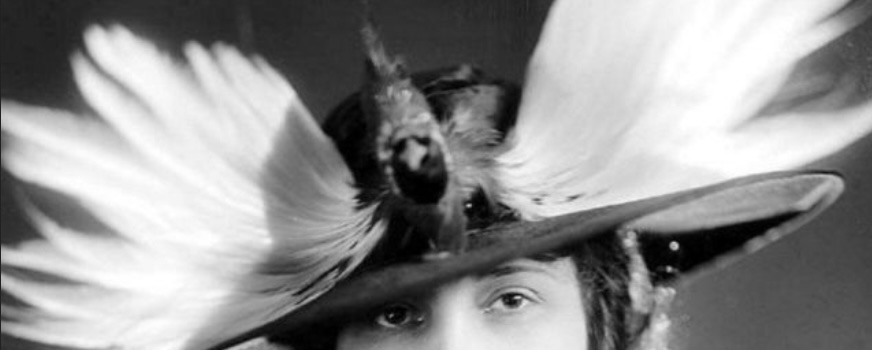
On Sunday mornings she could often be found in church, observing the congregation closely. Armed with a notebook and pen, she wrote down the names of any women whose hats were decorated with feathers. Margaretta ('Etta') Smith, later known as Etta Lemon, then wrote letters urging them to stop wearing feathers to spare the lives of birds which were being slaughtered for the sake of fashion. This was the start of her 50-year campaign against “murderous millinery.”
From the 1870s to the 1920s, the trade in feathers, known as plumasserie, was big business in London, Paris and New York. Birds-of-paradise, with their colourful and exotic plumage, were particularly sought-after, but no bird with suitable feathers was safe from the growing requirements of the millinery trade.
The feathers in the box were the authenticated proof of a despicable trade.
Commercial interests and consumer demand drove a lucrative business employing thousands of workers, mostly women, who washed and trimmed the feathers before they were stitched together, curled, and dyed to make them look more attractive.
The feather trade employed thousands of women and lent fashionable status to those who wore its products. Yet another smaller group of women were determined to stop the killing of birds on which it depended.
“One remarkable woman led the anti-plumage campaign of the Royal Society for the Protection of Birds — and she did so quietly and heroically for half a century, leading it to eventual victory,” says Tessa Boase in her book Etta Lemon: The Woman Who Saved the Birds.
Tessa Boase describes how Etta Lemon and her fellow campaigners descended on department stores and millinery shops in search of feather trimmings, questioning shop assistants and collecting samples, which they stored in a box as evidence. “The feathers in the box were the authenticated proof of a despicable trade,” writes Boase. “The box was labelled ‘contraband’ and it symbolised animal cruelty. Today, each feather represents a protected species.”
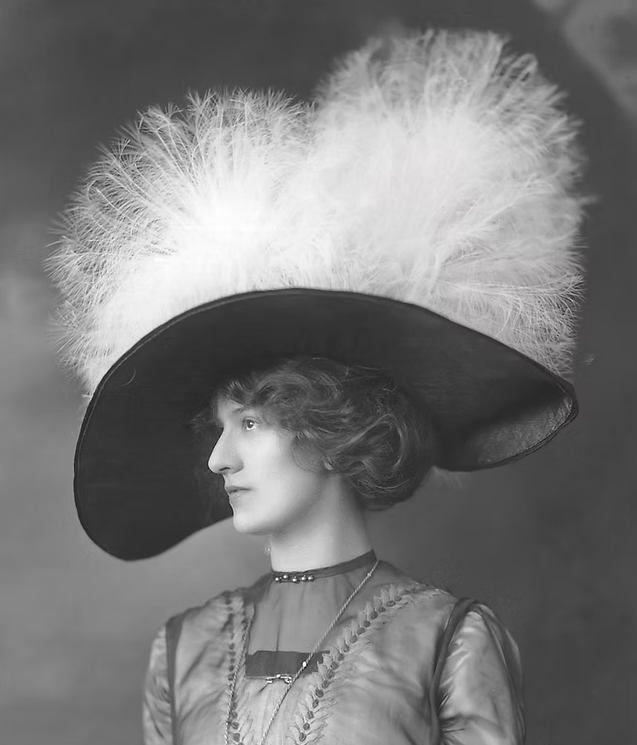
Consumer demand drove a lucrative business . . . breeding feathers of regrets and herons were harvested in massive quantities from places like Florida, Mexico, Venezuela, India, and China. [o]
The contents of the box were later stored in the archives of the Royal Society for the Protection of Birds, as a memento of the early beginnings of the charity. Its origins date back to 1889, when two separate groups were formed by female activists.
The first group was founded by Emily Williamson, who sent letters urging the all-male British Ornithologists' Union to take action. When these were ignored, she decided to set up her own group, and held meetings at her home in Manchester. Originally called The Plumage League, its rules were simple but direct
That Members shall discourage the wanton destruction of Birds, and interest themselves generally in their protection.
The Lady-Members shall refrain from wearing the feathers of any bird not killed for purposes of food, the ostrich only excepted.
Ostriches were made an exception to the rule because the feathers were clipped from farmed birds without killing them. Ostrich plumes were very popular and came in a variety of types and sizes, from tall white plumes to smaller black ones.
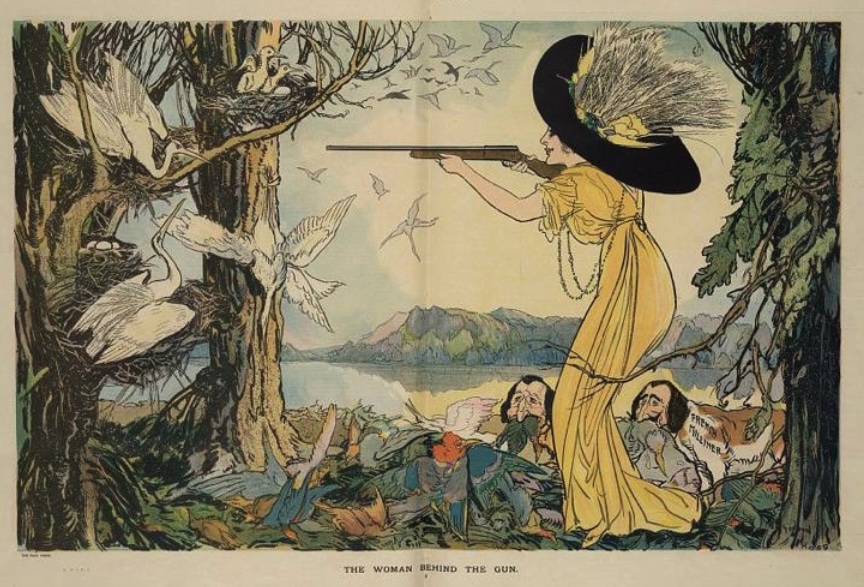
Crimes of fashion: an easy target . . . editorial cartoon published as a centerfold in the satirical magazine Puck, May 24, 1911. [o]
The second group, originally known as the Fur, Fin and Feather Folk, was run by Eliza Phillips, who lived in the London borough of Croydon. Emily and Eliza were brought together by their shared interests in wildlife conservation. In 1891, the two groups combined, taking the name of the Society for the Protection of Birds.
Etta Lemon played a key role in the newly merged society and became its honorary secretary in 1892. She campaigned for 50 years and became known as “the Mother of the Birds”.
As vice-president and publications editor, Eliza wrote the society’s first official leaflet, Destruction of Ornamental-Plumaged Birds, describing the damage to egret populations, which were prized for their soft white plumage. Under her editorial leadership, the Society for the Protection of Birds distributed over 50,000 leaflets and 15,000 letters a year during the 1890s, helping increase the society’s standing and membership.
The Duchess of Portland, Winifred Cavendish-Bentinck, became the society’s first president in 1891 and served in the post for 60 years. She was a stylish woman who set an example by refusing to follow the fashion trend for feathers and used her influence to promote the society’s cause. She was also a member of the Royal Society for the Prevention of Cruelty to Animals (RSPCA) and kept stables to take in horses and ponies needing homes.
In 1899, as a result of the society’s growing influence, Queen Victoria confirmed an order that certain military regiments should stop wearing “osprey” plumes — a fashion term generally referring to egret feathers. Five years later, King Edward VII awarded the Society a Royal Charter and it became the Royal Society for the Protection of Birds.
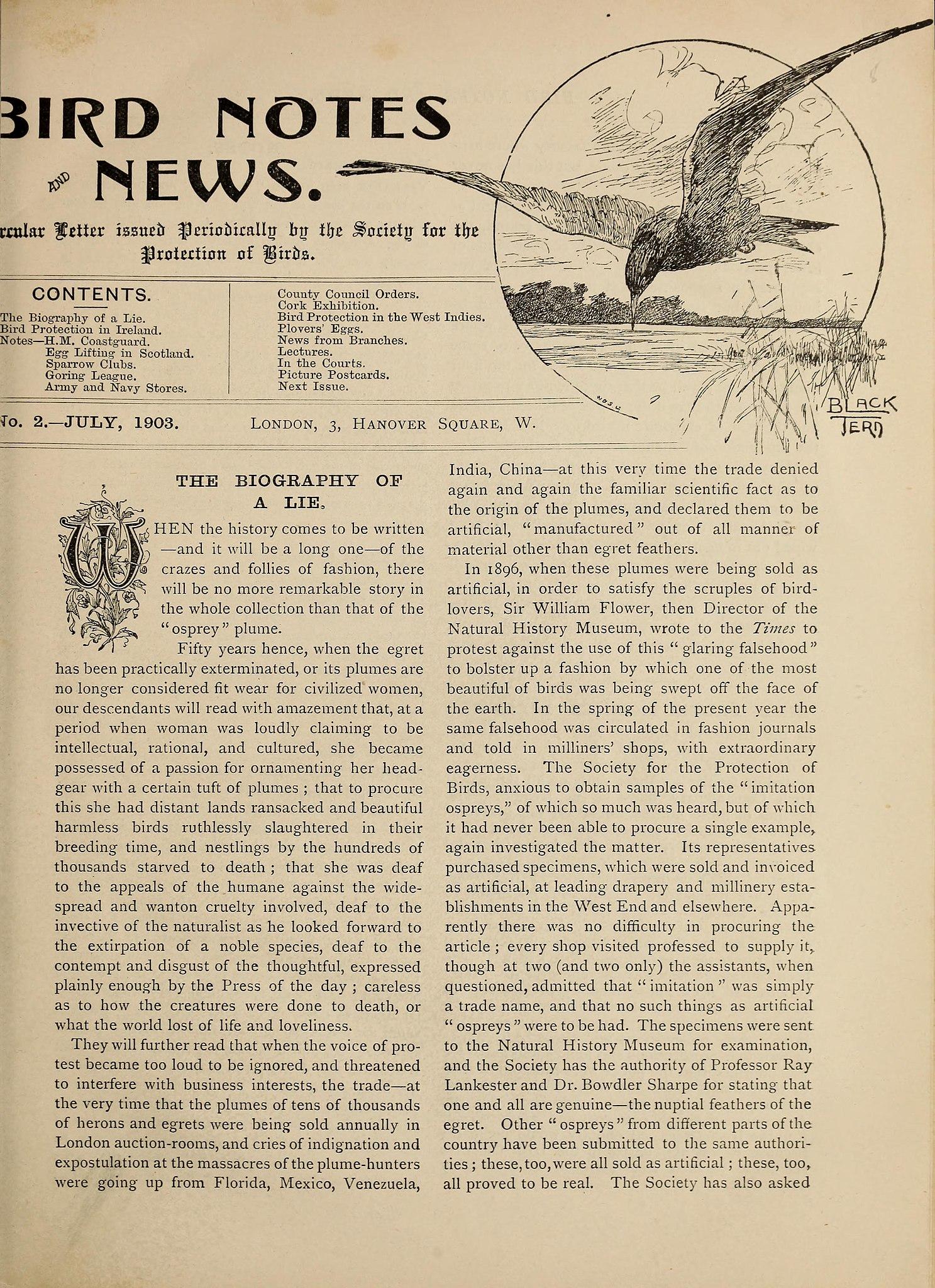
Women getting organized, long before they had the vote. [o]
The RSPB celebrated its first successful campaign in 1921, when the Importation of Plumage (Prohibition) Act was passed. With some exceptions, it prohibited imports of bird plumage from April 1922. In 1930, the Society established its first nature reserve in Romney Marsh. Minsmere in Suffolk became a reserve in 1947, and avocets, which had disappeared as breeding birds from Britain, returned to breed there. The RSPB now manages more than 200 nature reserves, protecting habitats for species such as the little egret and the great crested grebe, an elegant waterbird whose downy feathers were once used in place of fur.
The courage and determination of these women helped set a standard for wildlife conservation. They helped change what society considered fashionable. More fundamentally, they helped make cruelty to birds for the sake of fashion unacceptable. ō
LINKS
Royal Society for the Protection of Birds.
Royal Society for the Prevention of Cruelty to Animals
Etta Lemon: The Woman Who Saved The Birds

ANGELA LORD is the Nature Editor of the Journal of the Wild Culture. Originally from South Yorkshire, England, she studied Modern Languages then gravitated print journalism as a news reporter and feature writer. She is now a freelance writer based in Surrey, UK.
Add new comment