
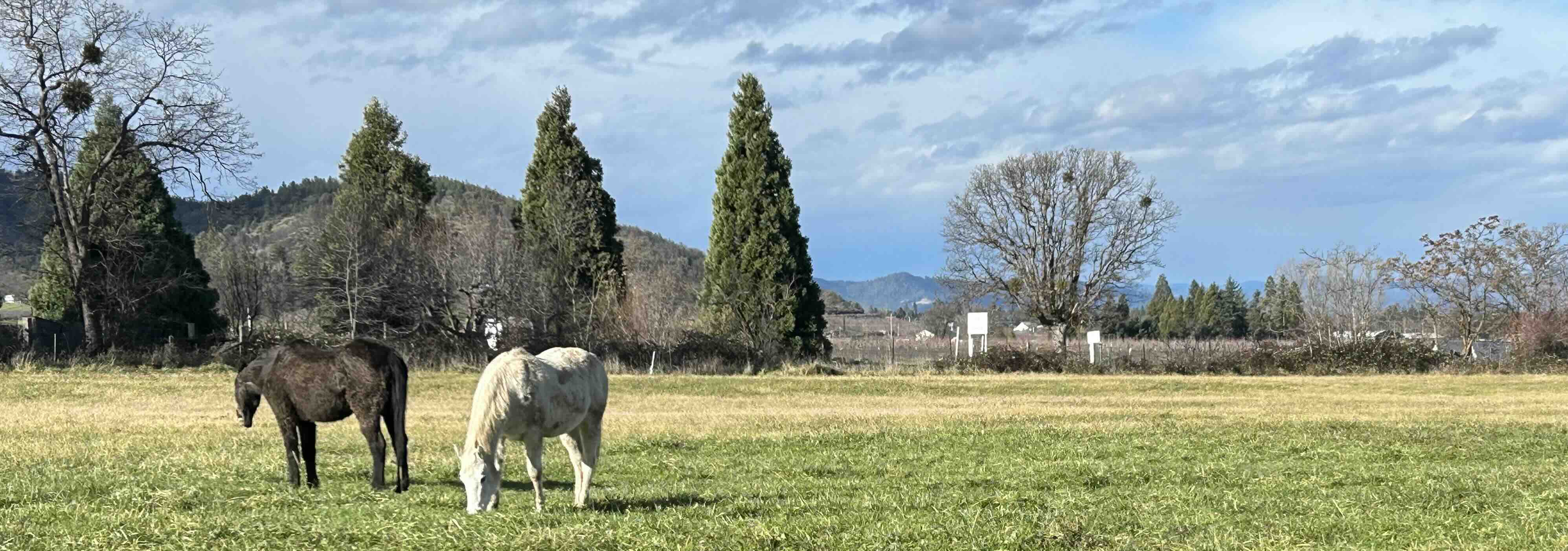
The other horse burst from the paddock and when she saw him there she charged away in a frenzied gallop down the dirt driveway, then a minute later careened past me by my front door, veering in directions I’d never seen her go before, running with a wild kind of untethered energy, mane and tail flying. No one yelled or called out. It was as if we were frozen in place watching her, leaving her to run in confusion, panic, fear, whatever it was propelling her.
That was two hours ago. I am sitting at the kitchen table and have just lit a votive candle and poured myself a generous glass of red wine. I’m not much good for anything else right now, other than crying.
I live on a farm. It’s not my farm. I rent a snug cottage that I share with my two cats. There is a canoe semi-hidden by dry grass and pussy willows on the bank of the small lake not far from my back door. Outside my front door is a large pasture and a weathered old barn with cobwebs in the windowpanes and, up until tonight, two horses and a couple of semi-feral working cats in residence who keep the mice and rats down. I am awakened every morning by Canadian geese honking as they fly high overhead, and in the spring and summer evenings the croaking of bullfrogs is so loud that when I first moved here — city girl that I am — I thought it was a donkey braying in a nearby field.
One of their advertisements read: "For those who simply have a desire to ride horses and be a part of a team."
Farm life, I have found, is different. Full of nature, animals and the rolling cycles of life. Gnarled oaks, tall willows and flowery mimosa trees provide shade. A tended vegetable garden produces an abundance of squash, tomatoes and cucumbers. Wildflowers of purple and gold color the fields. Hardy daffodils and tulips — from bulbs planted long ago — sprout randomly near the pale yellow, wood-shingled farmhouse. Over a dozen rescue animals live here, including hens, a turkey named Gus, two large dogs, cats, and horses. Also deer, skunks, foxes, the occasional heron and egret, hawks and coyotes that sometimes wander through these eight acres. Once, a mama bear and her cubs.
When I moved here not long ago during a painful life transition, I had no idea I would have the privilege of living close to two horses. Often I walked out to the barn at dusk to feed them apple and carrot treats, whispering and rubbing their long necks and soft muzzles. To those who know them, horses are special, almost magical creatures. As a young girl, my bedroom shelves were full of plastic models of all breeds — my favorites being the Pinto and Appaloosa. I dreamed of owning my own horse but the best my parents could offer on Dad’s salary was membership in the California Rangers, a non-profit youth equestrian organization — modelled, I understand, after the 1800’s cavalry, complete with military rankings and uniforms. One of their advertisements read: ". . . for those who simply have a desire to ride horses and be a part of a team." It still exists today.
For my equine-crazy adolescent self at the time, in Burbank where I grew up, it was an affordable way to ride horses, for most a prohibitively expensive hobby. I remember being told by a smirky older teen that we might be called up at any moment for search and rescue assignments in the nearby Verdugo Hills. I have no idea if this was true, but I loved the idea of saddling up and heading off as a unit to apprehend an escaped bad guy or rescue a missing hiker. Of course, other than in my imagination, this never happened. What we did do was compete regularly in horse shows where we executed precision drill maneuvers. By the age of 13 I had became an accomplished and disciplined rider with a box full of blue ribbons.
Life moved on and my interest in horses waned. In middle school I thought of little but when the next dance was and what boy I might flirt with. My riding boots and the box of ribbons were shoved under the bed and the plastic horse models made their way into a bag labelled DONATE. I don’t remember ever giving that bag away, but it must have happened sometime around my parents’ divorce when I was a teen. In a bitter split, a For Sale sign went up in the front yard and piles of our possessions were set out for the trash by Mom.
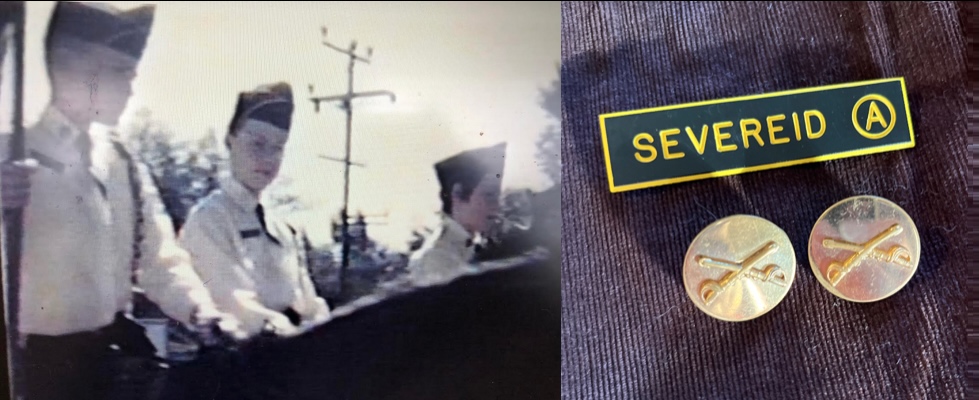
The author as a California Ranger (center) and her buttons. The ribbons went out with the trash.
These memories are flooding back to me now because today one of the horses had to be put down. Tyler was old, 32, a ripe age for any horse, much less one rescued a long time ago from what I’m told was a brutal life as a racetrack horse. He was one of the lucky ones. Once his paydays were over he found a loving home with kind people. Today’s decision was made after a foot infection refused to heal. It was Tyler’s time, so we all knew that today would be tough. No, let me rephrase that. Not a tough day, searingly sad describes it better.
The veterinarian drove up followed by a large truck with high metal sides (to block any view of its contents) and pulling a hydraulic lift and winch. The mind tries to find places for such images, images with hard edges. Winch. Hydraulic lift. But the carcass of a horse weighs a thousand pounds or more. It’s part of the nuts and bolts of death.
I could see Tyler from my front window, the one that looks out to the barn. They coaxed him out of the stall into the field. Even old, he appears as a noble steed — a former racehorse, a thoroughbred pushed to his limits many, many times. Somehow that made it harder to watch.
Once sedated, his head drooped and he buckled under his own weight. A small semi-circle of people surrounded him and the big truck edged closer. The vet positioned herself to help with the death of an old horse making the final exit from his life on the farm. I looked away for just a bit, and when I looked back again he was no longer standing. On the ground, the semi-circle drew closer around him. A couple of minutes later I heard the truck’s rear gate clang shut. I have no idea how they did that so fast. I don’t want to know.
Horses are big. Not just in size, but in the place they can take up in our lives and hearts. They carry us. They pull our plows and toil for us. They trust us for their every need, including love and affection. Like elephants and big old dogs, there is a specialness to horses that’s hard to describe. Watching an animal so large and powerful go down, or seeing them lying motionless on the ground, it made me think of seeing a strong, all-knowing, all-powerful father cry for the first time.
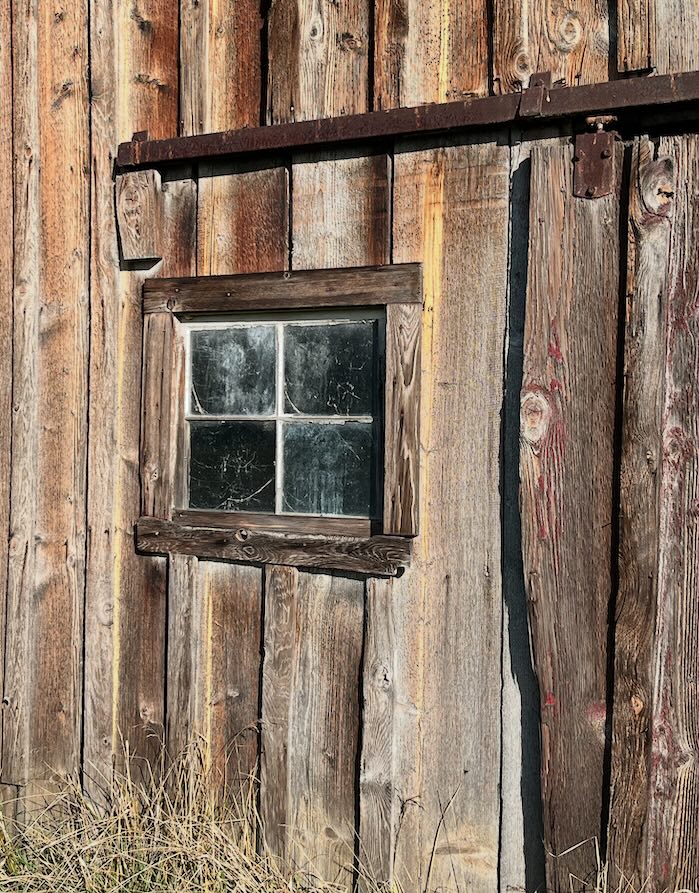
"We are the living and the quick, and it is not possible to pierce that veil."
I began this story with what happened minutes after Tyler lay dead on the ground. The other horse, Zephyr, after her fraught darting in all directions, made her way slowly back to the pasture. Later in the barn that night, she cried and whinnied for hours, even as the owners comforted her. Restlessly, she circled the paddock, and walked back and forth in and out of the two stalls she and Tyler had shared for fifteen years. Even the barn cats were yowling. It was the dark, strange, impossible energy of death.
I have read that any new death can cause the grief of previous deaths and losses in our life to resurface. I don’t know about that, but I do know that as we age we will suffer more and more losses that rob us of those we love: partners and spouses, parents, siblings, best friends, relatives, even children. I do not believe that we are meant to understand death. We are the living and the quick, and it is not possible to pierce that veil. But for me, the finality of death is perhaps the most difficult part of being human. There are no re-dos, and the death of Tyler tore my heart open anew.
The big truck drove off with him in the back. I bowed my head. I was silent. I thanked the old horse for being part of my life, if only for a brief while. The truck reached the end of the long drive, turned left and was gone. ō

SUSANNE SEVEREID is an author and actor/presenter working in journalism and the performing arts. She is the author of several books and was the on-camera anchor/narrator for C.A.N.D.L.E.S.: The Story of the Mengele Twins, filmed on location in Auschwitz. Susanne lives in the Pacific Northwest. View Susanne's site.
Photographs by the author.
Comments
Hugs to you, Susanne. It is…
This is such a moving story and a poignant part of life. So many people do not realize just how much grief and emotion animals can feel; it's time people realize that animals are sentient beings deserving of our respect and care, not just things to be exploited. Thank you for bringing that grief to life in this story.
I found this story about an…
I found this story about an old horse who had lived his days particularly moving and impactful. We all can identify with the feelings this event evokes with the humans who have taken care of the horse. Death is part of life, but remains a mystery. If it involves a family member, friend or close animal we feel lost in all the emotions we are encountering. An important one is gratefulness for the affection we have felt and will feel.
The article describes the plethora of reactions in a beautiful way!
Just as there are special…
Just as there are special people, there are other special animals who pierce the heart when they leave us. Wonderful piece on connections, loss and facing the unknown.
I found myself pressing my…
I found myself pressing my hand to my chest, trying to keep my heart in one piece as I read this deeply touching story. It really got to the quick of the pain of death and its unfathomable mystery. The nobility of the horse spirit is so beautifully evoked here, too. Susanne has a great gift for taking readers from familiar events like horseback riding into a realm of contemplation that is rich and rewarding.
This poignant essay…
Add new comment